 Backstory Report
AirCase File 006
A 767 Runs Out of Fuel Mid-Flight
The gauges were blank, so the fuel was measured by hand. One factor turned litres into the wrong unit.

What the report found
- The fuel was converted with 1.77, a factor for pounds, where about 0.8 was needed for kilograms (pp. 28, 41 to 42).
- The aircraft left Montreal and Ottawa with blank fuel gauges, contrary to the minimum equipment list (pp. 35 to 36).
- The Board found a combination of causes and called a metric mix-up alone "simplistic and inaccurate" (p. 35).
The film

12 min. The film goes up on the Backstory Report channel; its full narration is the story below.
A fuel warning at 41,000 feet
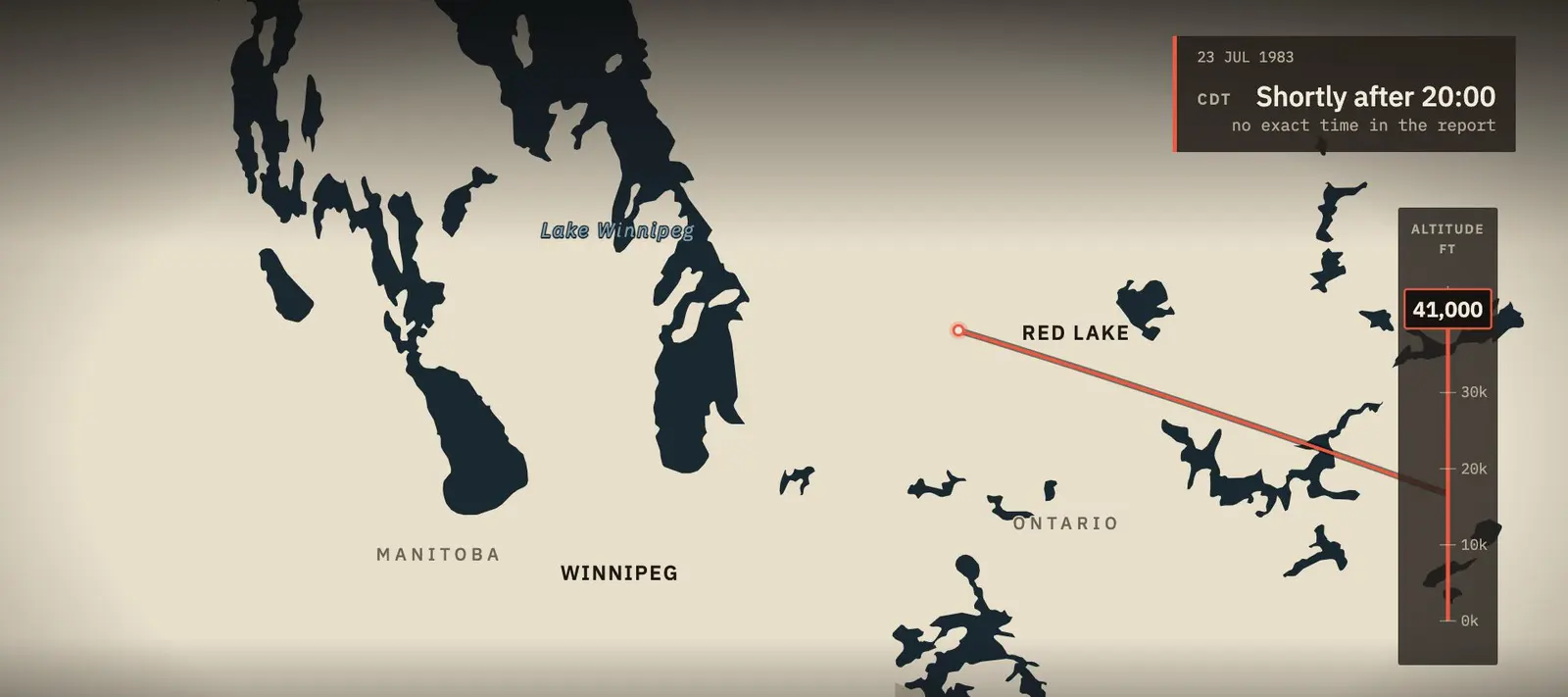
Forty-one thousand feet over northwestern Ontario, just after eight in the evening. A new Boeing 767 is flying to Edmonton with sixty-nine people on board. A warning shows low fuel pressure in the left fuel pump.
Within minutes, both engines fail. The screens on the flight deck go blank. The tanks are dry, because a sum on the ground gave its answer in pounds, and everyone read it as kilograms.
The factor in that sum was one point seven seven. For kilograms, it needed to be about zero point eight. The aircraft glides to a disused military airfield at Gimli, Manitoba. Everyone on board lives.
A new 767 with fuel gauges in kilograms
This film is built from one document: the final report of the Board of Inquiry led by Justice George Lockwood, published in April nineteen eighty-five. Every number comes from it, page by page.
“the conversion factor of 1.77 lbs. per litre”
p. 28, Board of Inquiry, Final Report, April 1985
On Saturday the twenty-third of July, nineteen eighty-three, Air Canada flight one four three was to fly from Montreal to Edmonton, with a stop at Ottawa. On board were sixty-one passengers, six cabin crew, a captain and a first officer.
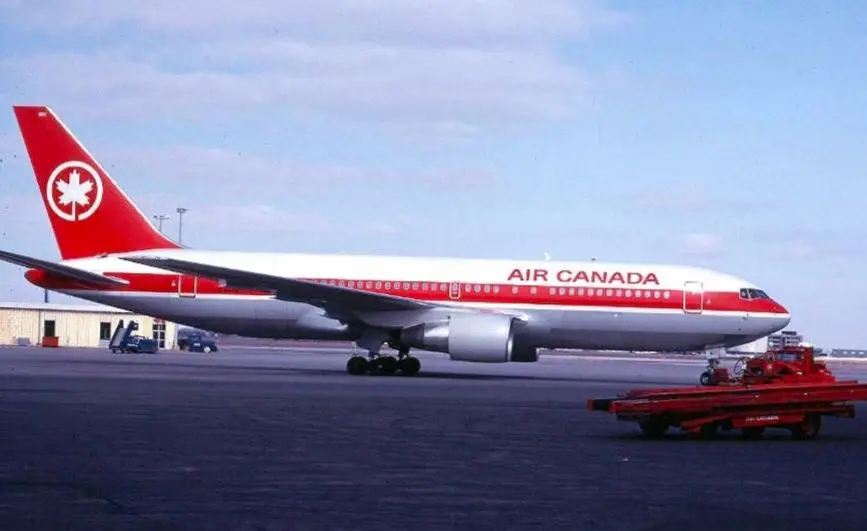
The aircraft was one of the airline's newest, a Boeing 767, built to be flown by two pilots instead of three. Its fuel gauges read in kilograms.
The fuel gauges go blank
Three fuel gauges on the flight deck were run by a processor with two channels. It had failed before, on the fifth and the fourteenth of July. On the night of the twenty-second, in Edmonton, the gauges went blank again. A technician pulled the circuit breaker for channel two, which brought them back, and taped it. The aircraft flew on, with the fuel checked by hand.
In Montreal, a second technician, puzzled by the log entry, ran the processor's self-test. To do it, he reset the channel two breaker, and the gauges went blank. Distracted when the fueller arrived, he forgot to pull the breaker out again.

After a short talk with the outgoing crew, the incoming captain believed the gauges had been blank since the day before. He found them blank, and the taped breaker, and took both as the fault he expected. Both assumptions, the Board found, were wrong. The minimum equipment list required at least two working gauges out of three, and the captain knew it.
He testified that a technician told him maintenance control had cleared the flight. The Board found no such clearance had been given. He decided it could fly if the fuel was measured by hand, with sticks under the wings, in Montreal and again in Ottawa. The Board found the departure was not permitted, and a significant cause of the accident.
Centimetres, litres and a factor of 1.77
A drip stick is pulled down from under the wing, and the depth of fuel is read off its scale, in centimetres. Then two more steps. Centimetres to litres, from a table kept on the aircraft. Litres to kilograms, with a conversion factor.
“requested by the flight crew to board 5000 litres, one quarter of the required amount”
p. 41, Board of Inquiry, Final Report, April 1985
At the time, that factor was called the specific gravity. In Montreal, the first officer asked the fueller for it, and was given one point seven seven. That is the weight of a litre of fuel in pounds. In kilograms, a litre weighs about zero point eight.
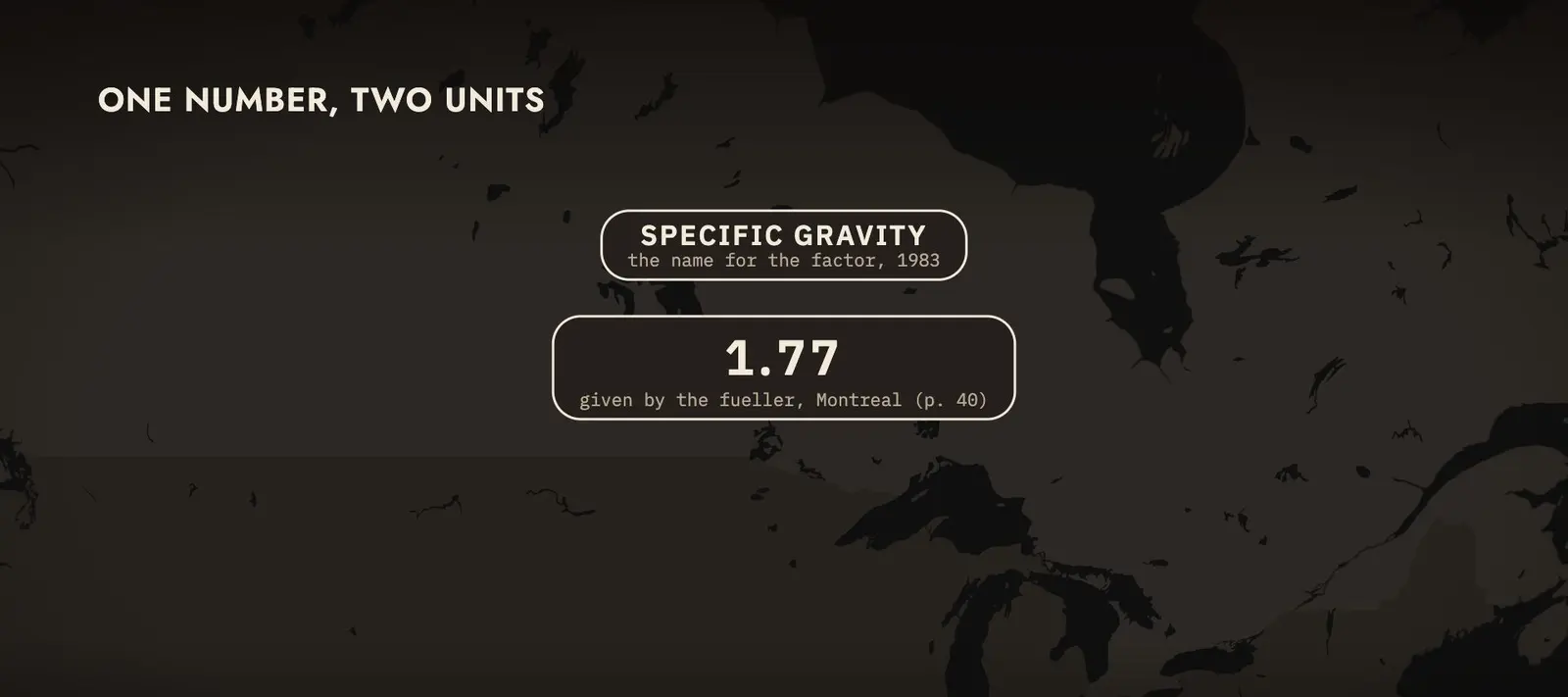
The fuelling companies gave the same figure for every aircraft in the fleet. For the aircraft that used pounds, it was right. For the 767, it was the wrong unit.
No one making the calculation in Montreal had been trained to do it. The Board wrote that if the flight crew had consulted their operations manual, they would have found the method: divide pounds by two point two, with zero point eight zero for jet fuel.
The sum as the Board set it out
Here is the sum as the Board set it out. The first drip read sixty-four and sixty-two centimetres. The table turned those into three thousand nine hundred and twenty-four litres, and three thousand seven hundred and fifty-eight. Seven thousand six hundred and eighty-two litres in the tanks.
Step two. Seven thousand six hundred and eighty-two, times one point seven seven, is thirteen thousand five hundred and ninety-seven. That number was in pounds. Everyone involved read it as kilograms.
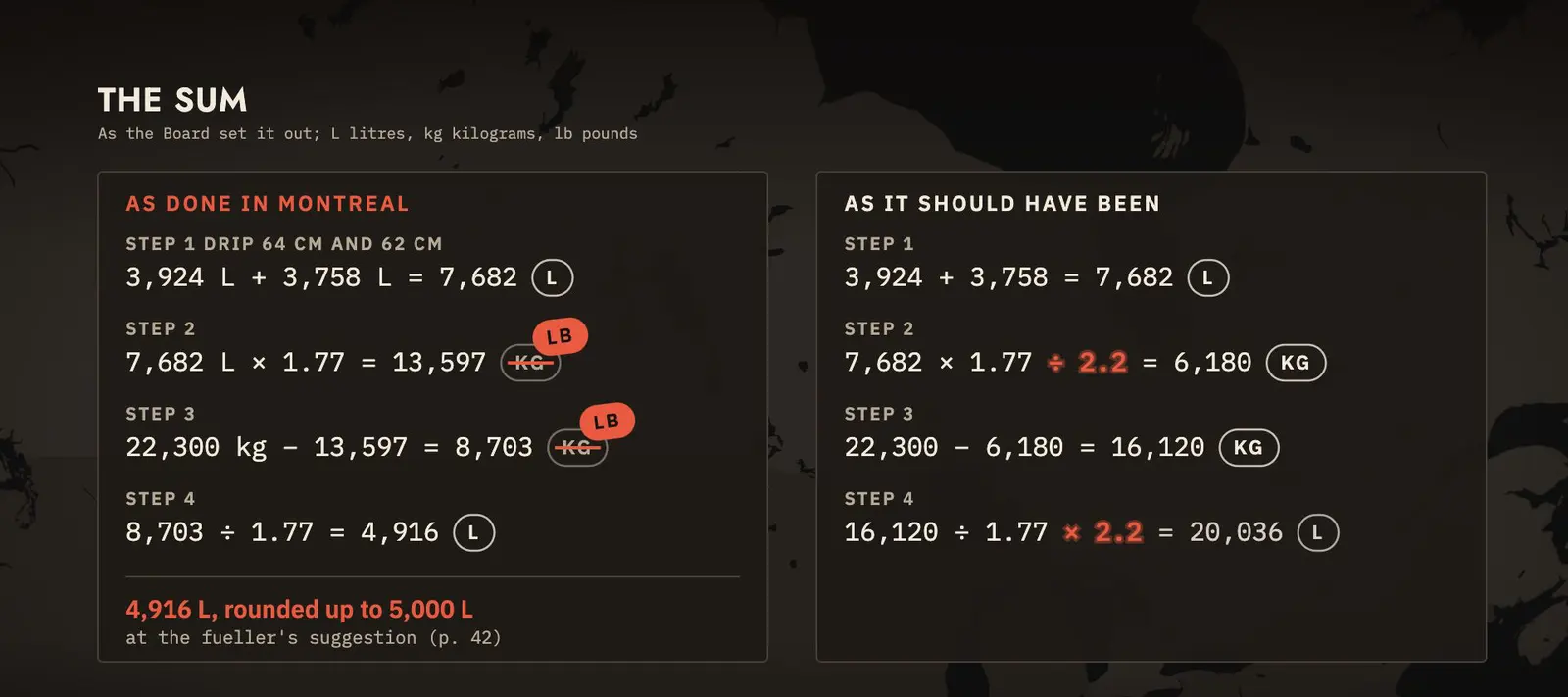
Step three. The flight plan's minimum fuel for the trip was twenty-two thousand three hundred kilograms. Take away thirteen thousand five hundred and ninety-seven, and eight thousand seven hundred and three seemed to be needed.
Step four. Divide by one point seven seven to get litres: four thousand nine hundred and sixteen. The fueller suggested rounding up to five thousand litres.
The captain went over the longhand figures with his calculator. He told them: “your calculations to me look mathematically correct.” The arithmetic was correct. The unit was not.
The Board then did the sum correctly. Seven thousand six hundred and eighty-two litres, times one point seven seven, divided by two point two: six thousand one hundred and eighty kilograms on board. Twenty-two thousand three hundred, less six thousand one hundred and eighty, leaves sixteen thousand one hundred and twenty kilograms to load. In litres, twenty thousand and thirty-six.
Five thousand litres went in. About twenty thousand were needed, four times as much. The aircraft left Montreal with about half the fuel the crew believed it had.
Redo the sum. Type the factor and watch the tanks.
The gauges were blank, so the fuel on board was measured with drip sticks: 64 cm and 62 cm, which the drip table turns into 3,924 and 3,758 litres (pp. 41, 42). The flight plan needed 22,300 kg. Everything after that depends on one number: how many kilograms a litre of fuel weighs.
- 13,924 + 3,758 = 7,682 LBoard, p. 42
- 27,682 × 1.77 = “kg”
- 322,300 − = “kg” to add
- 4 ÷ 1.77 = L to board
What actually went in
Real weight worked out here with the Board's own conversion: litres × 1.77 ÷ 2.2 (p. 42). Figures marked “calculated here” are this page's arithmetic from the report's numbers, not the report's.
- 3,758 + 3,924 = 7,682 Lp. 42; p. 41
- 7,682 x 1.77 = 13,597p. 42; p. 41
- 22,300 - 13,597 = 8,703p. 42; p. 41
- 8,703 / 1.77 = 4,916p. 42; p. 41
- 4,916 to 5,000 Lp. 42
- 3,924 + 3,758 = 7,682 Lp. 42
- 7,682 x 1.77 / 2.2 = 6,180 kgp. 42
- 22,300 - 6,180 = 16,120 kgp. 42
- 16,120 / 1.77 x 2.2 = 20,036 Lp. 42
- four timesp. 42
Ottawa checks the fuel with the same error
In Ottawa, the fuel was measured again, as a check. Eleven thousand four hundred and thirty litres, at a factor of one point seven eight. The captain's answer was over twenty thousand, what the crew expected to see. The same error, and no alarm.
“the 4900 litres was rounded to 5000 litres at his suggestion”
p. 42, Board of Inquiry, Final Report, April 1985
That morning in Edmonton, the outgoing crew had done the same conversion correctly, with a factor of around zero point eight.
Both engines fail at 35,000 feet
Just after eight in the evening, Central time, at forty-one thousand feet, a warning showed low fuel pressure in the left fuel pump. The captain turned for Winnipeg, a hundred and twenty miles away, and began to descend.
Within seconds, a second warning: low pressure in the right main tank. Within minutes, the left engine failed, then the right. The aircraft was at thirty-five thousand feet, sixty-five miles from Winnipeg, and forty-five miles from Gimli.
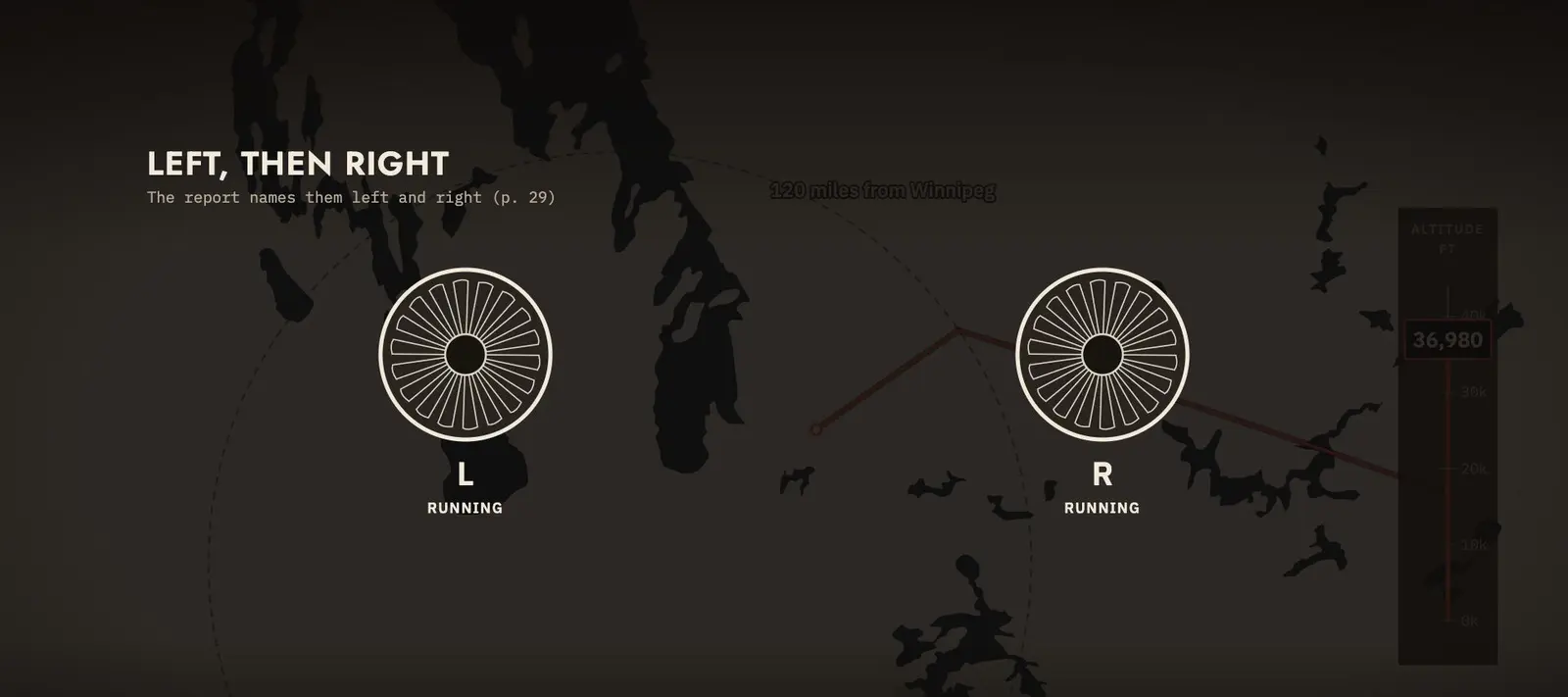
With both engines out, there was no power for the screens. The pilots had four standby instruments: a magnetic compass, an artificial horizon, an airspeed indicator and an altimeter.
Neither pilot could read the compass accurately, so the captain judged his turns against the tops of the clouds. There was no standby instrument for the rate of descent.
So the first officer worked it out by hand. He asked Winnipeg for their distance, noted the height, and asked again. From those pairs he worked out, in the captain's words, some sort of a profile for descent. The flight recorders had stopped with the engines, and kept nothing of the glide.
Three weeks of a fault, one evening, and the inquiry
The report gives few clock times, so most entries carry only a date. The map marks where each part of the last flight happened.
- 5 July 1983No clock time in the report
Fuel gauge processor fault on this aircraft, Edmonton
p. 99; p. 87 - 22 July 1983, nightNo clock time in the report
Edmonton: gauges blank at a service check; channel 2 breaker pulled and collared with tape; dispatched under MEL item 28-41-2
pp. 25 to 26; pp. 99 to 100 - 23 July 1983No clock time in the report
Montreal: first drip 64 and 62 cm, 7,682 L; the sum; 5,000 L requested and boarded
pp. 41 to 42 - 23 July 1983No clock time in the report
Ottawa: drip as a check, 11,430 L at 1.78, "over 20,000"; no alarm
pp. 42 to 43 - 23 July 1983, shortly after 20:00 CDT
First warning, low fuel pressure in the left fuel pump; diversion to Winnipeg, 120 miles; descent from 41,000 ft
p. 28 - 23 July 1983No clock time in the report
Left engine fails, then the right; 35,000 ft, 65 miles from Winnipeg, 45 from Gimli; screens blank; flight recorders stop
p. 29; p. 17; p. 100 - 23 July 1983, 20:32 CDT
Turn toward Gimli, some 12 miles away, in consultation with air traffic control
p. 29 - 23 July 1983No clock time in the report
Sideslip on final approach; touchdown within 800 ft of the threshold
p. 29 - 23 July 1983No clock time in the report
Evacuation, very quickly; rear chutes steep and short of the ground; both tanks found dry
p. 29; pp. 101 to 102 - 12 Oct 1983
Board of Inquiry established, Justice George H. Lockwood sole member
Preface p. 1; pp. 9 to 10
The full record, 24 entries
- 5 July 1983 Fuel gauge processor fault on this aircraft, Edmonton p. 99; p. 87
- 14 July 1983 Gauges go blank en route from Toronto to San Francisco, same aircraft p. 99; p. 87
- 22 July 1983, night Edmonton: gauges blank at a service check; channel 2 breaker pulled and collared with tape; dispatched under MEL item 28-41-2 pp. 25 to 26; pp. 99 to 100
- 23 July 1983, morning Edmonton: the outgoing crew and fueller do the drip calculation correctly, factor around .8 p. 44
- 23 July 1983 Montreal: a technician runs the BITE test, resets the channel 2 breaker, gauges go blank; distracted by the fueller, he leaves it in pp. 26 to 27
- 23 July 1983 Montreal: the incoming captain, after talking with the outgoing crew, believes the gauges have been blank since the day before p. 26; pp. 36 to 37
- 23 July 1983 Montreal: decision to fly with the fuel confirmed by drip sticks in Montreal and Ottawa pp. 27 to 28
- 23 July 1983 Montreal: first drip 64 and 62 cm, 7,682 L; the sum; 5,000 L requested and boarded pp. 41 to 42
- 23 July 1983 Departure from Montreal with blank gauges ("an illegal dispatch") p. 44; p. 28
- 23 July 1983 Ottawa: drip as a check, 11,430 L at 1.78, "over 20,000"; no alarm pp. 42 to 43
- 23 July 1983 Departure from Ottawa with blank gauges p. 28
- 23 July 1983, shortly after 20:00 CDT First warning, low fuel pressure in the left fuel pump; diversion to Winnipeg, 120 miles; descent from 41,000 ft p. 28
- 23 July 1983 Second warning, loss of pressure in the right main fuel tank pp. 28 to 29
- 23 July 1983 Left engine fails, then the right; 35,000 ft, 65 miles from Winnipeg, 45 from Gimli; screens blank; flight recorders stop p. 29; p. 17; p. 100
- 23 July 1983 The first officer builds a descent profile from distances given by Winnipeg and altitudes he notes pp. 100 to 101
- 23 July 1983 Flight attendants have instructed the passengers in emergency procedures p. 29
- 23 July 1983, 20:32 CDT Turn toward Gimli, some 12 miles away, in consultation with air traffic control p. 29
- 23 July 1983 Alternate gear extension: the gear falls by its own weight; mains lock, the nose wheel does not p. 101
- 23 July 1983 Sideslip on final approach; touchdown within 800 ft of the threshold p. 29
- 23 July 1983 Nose wheel collapses, the nose scrapes and slows the aircraft; it stops before the drag racing camp p. 29; p. 101
- 23 July 1983 Evacuation, very quickly; rear chutes steep and short of the ground; both tanks found dry p. 29; pp. 101 to 102
- 12 Oct 1983 Board of Inquiry established, Justice George H. Lockwood sole member Preface p. 1; pp. 9 to 10
- 21 June 1984 Interim Report: left Montreal and Ottawa with inoperative gauges and insufficient fuel p. 9
- April 1985 Final Report published cover
The turn for Gimli and one chance to land
It soon became clear they could not reach Winnipeg. At eight thirty-two, working with air traffic control, the captain turned toward Gimli, about twelve miles away on the western shore of Lake Winnipeg. In the cabin, the flight attendants had already briefed the passengers on emergency procedures.
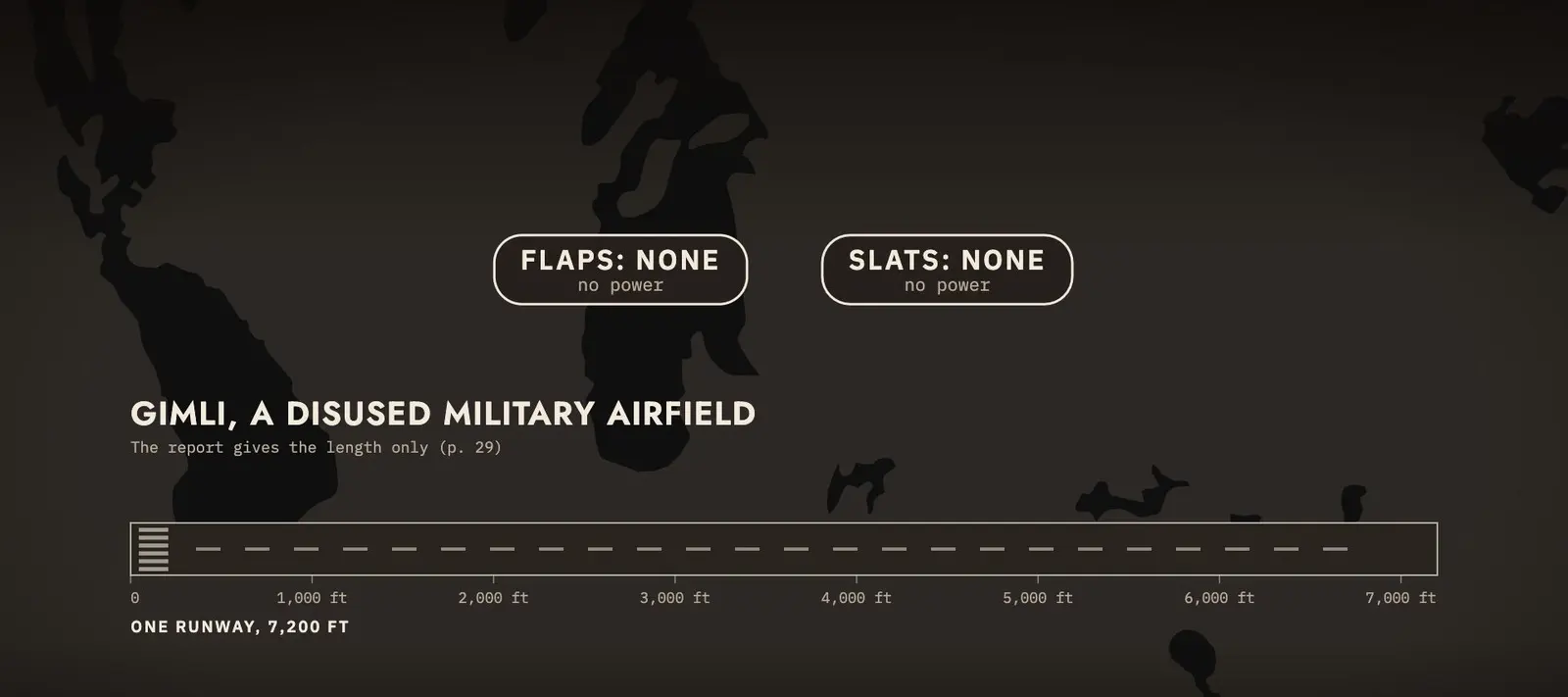
The captain was also a glider pilot, and he used gliding techniques to fly the 767. With no power, there were no flaps or slats to control the descent. There would be one chance to land, on seven thousand two hundred feet of runway.
The landing gear needed hydraulic power, and there was none. Shortly before touchdown, the first officer used the alternate gear switch, and the gear fell by its own weight. The main wheels locked. The nose wheel did not.
On the final approach, the captain put the aircraft into a sideslip, to lose height and speed and land close to the start of the runway. It touched down within eight hundred feet of the threshold.
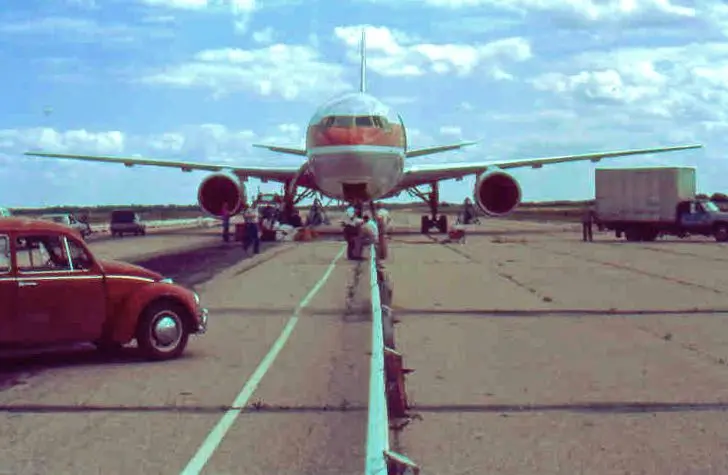
The nose wheel collapsed, and the nose scraped along the concrete. The friction helped slow it. The far end of the runway was in use as a drag racing strip, with drivers and their families camped beyond it for the weekend. The aircraft stopped before it reached them.
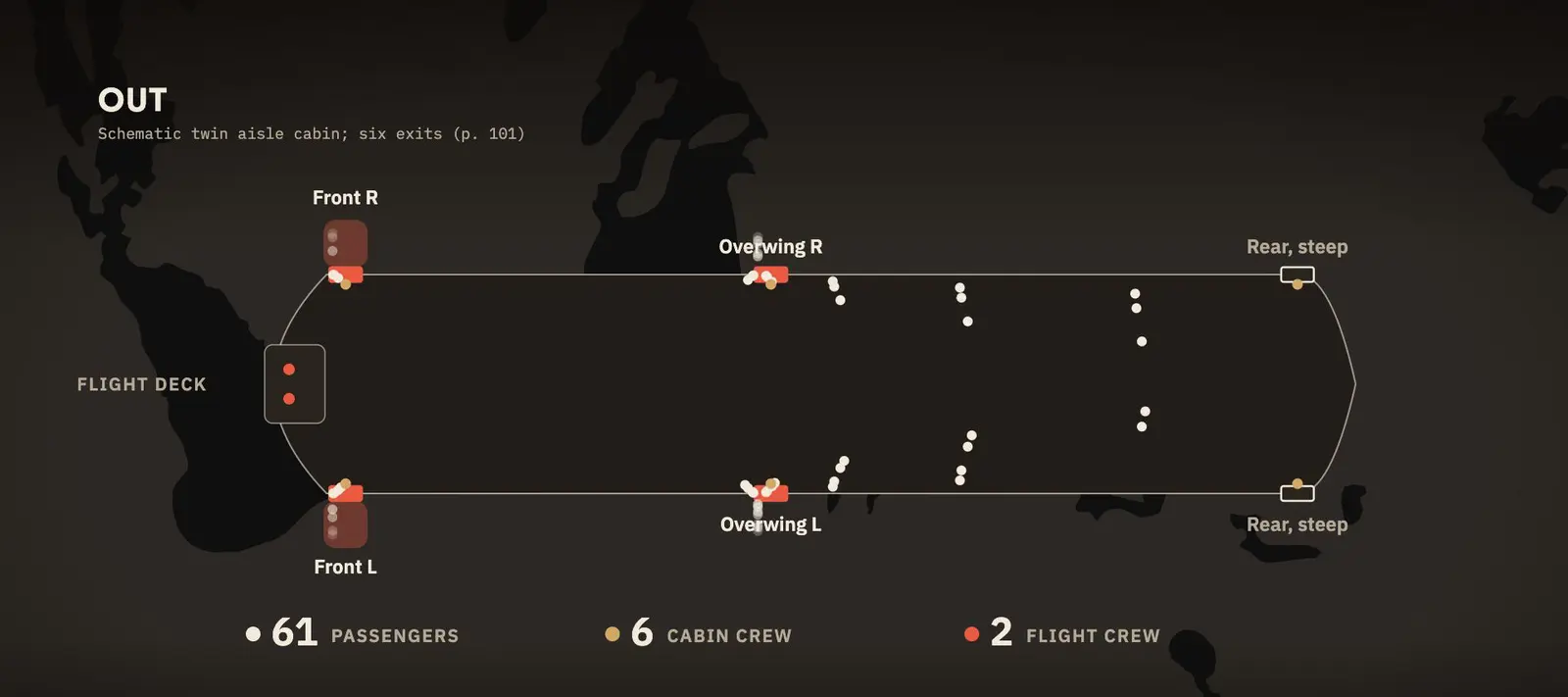
Everyone was out very quickly. The rear slides were steep, and did not reach the ground. The investigators credited the evacuation's success to the small number of passengers and the absence of fire. Both fuel tanks were found to be dry.
The Board found a combination of causes
The Board found a combination of causes. “To suggest that the accident was the result of a metric mix-up is simplistic and inaccurate.”
“There is no evidence to suggest that anyone either shirked or attempted to shirk his responsibility”
p. 38, Board of Inquiry, Final Report, April 1985
It found errors by maintenance staff and by the flight crew, in Montreal and in Ottawa. It also found no one had shirked the job of working out the fuel. They had tried to help each other.
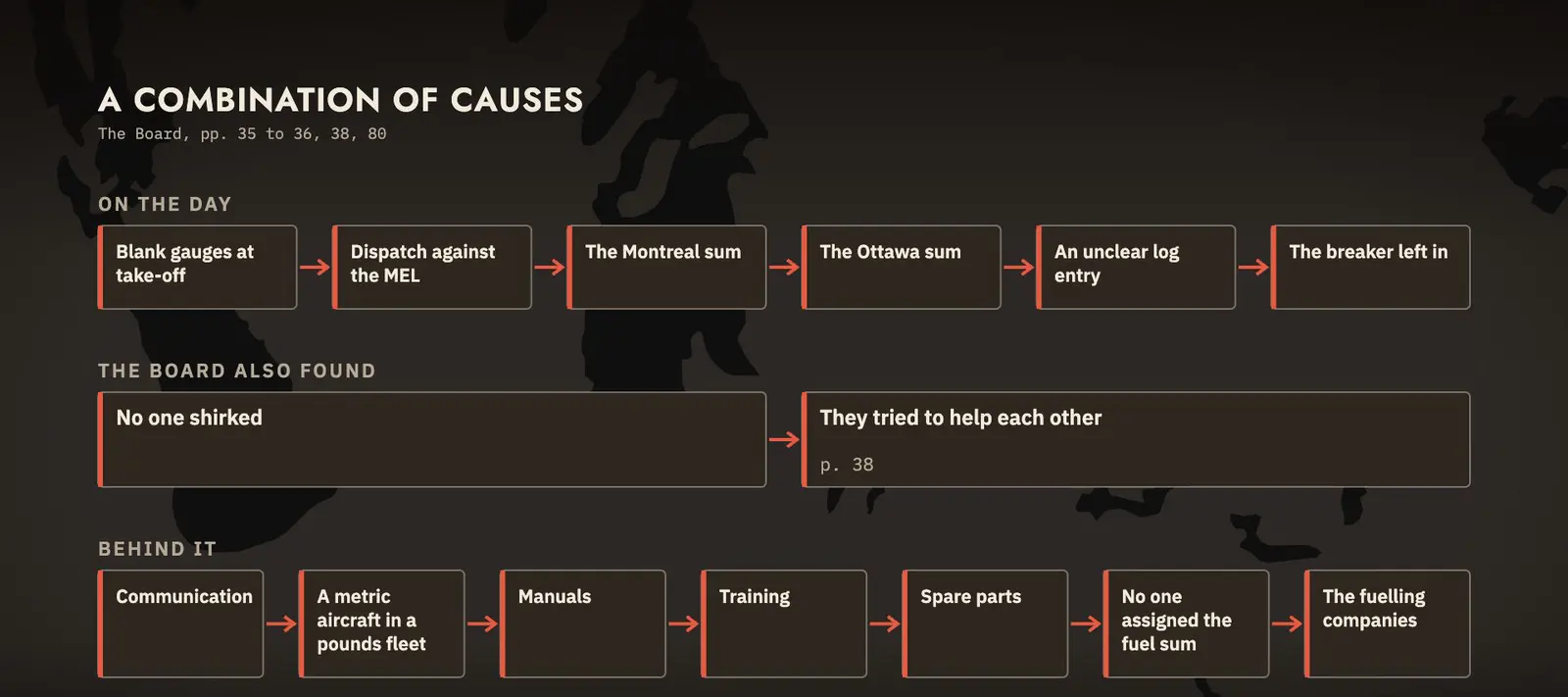
And it said the responsibility went further, into the airline's management. It named a failure of communication, a metric aircraft in a fleet that used pounds, unclear manuals, too little training, and no one clearly given the job of the fuel calculation. The fuelling companies shared responsibility for the wrong factor.
What changed after the inquiry
By the time the report came out, the airline's drip charts went straight from centimetres to kilograms. The words specific gravity were gone from the fuel slip. Flight crew and maintenance each worked out the fuel, and compared answers.
The Board recommended one system of units across the whole fleet, and that it be metric. It asked for a rate of descent indicator, and flight recorders, that would keep working on emergency power.
Twenty-two thousand three hundred kilograms needed. About half of it on board. One point seven seven, where about zero point eight belonged.
Sixty-one passengers, eight crew, and no lives lost. Source: the Board of Inquiry's final report, April nineteen eighty-five.
What changed after
- Air Canada's drip charts now convert drip stick readings in centimetres straight to weight in kilograms.p. 127, Board of Inquiry, Final Report, April 1985
- The fuel sum is assigned to crew and maintenance jointly; each works it independently and they compare their findings.p. 128, Board of Inquiry, Final Report, April 1985
- The term "specific gravity" was removed from the fuel slip and replaced with "Fuel Weight Conversion Factor".p. 128, Board of Inquiry, Final Report, April 1985
- The Board recommended a move towards one system of units, based on the metric system.pp. 129, 131, Board of Inquiry, Final Report, April 1985
- It recommended a vertical speed indicator, and the flight recorders, on emergency power.p. 138, Board of Inquiry, Final Report, April 1985
Fact check and sources
The Board of Inquiry, on the idea that this was a units error and nothing more:
“To suggest that the accident was the result of a metric mix-up is simplistic and inaccurate.”
Board of Inquiry, Final Report, April 1985, p. 35
Checked against the record
- 1.77 The figure the fueller gave in Montreal.
the conversion factor of 1.77 lbs. per litre
p. 28, Board of Inquiry, Final Report, April 1985 - 5,000 L What the crew asked for and boarded.
requested by the flight crew to board 5000 litres, one quarter of the required amount
p. 41, Board of Inquiry, Final Report, April 1985 - 4,900 to 5,000 A last rounding.
the 4900 litres was rounded to 5000 litres at his suggestion
p. 42, Board of Inquiry, Final Report, April 1985 - No one shirked The Board on the people involved.
There is no evidence to suggest that anyone either shirked or attempted to shirk his responsibility
p. 38, Board of Inquiry, Final Report, April 1985
Sources
- Board of Inquiry (Commissioner the Hon. Mr. Justice George H. Lockwood), Final Report of the Board of Inquiry investigating the circumstances of an accident involving the Air Canada Boeing 767 aircraft C-GAUN that effected an emergency landing at Gimli, Manitoba on the 23rd day of July, 1983, April 1985, Catalogue No. T22-64/1985E. Scan hosted by the US Federal Aviation Administration
- Short quotations from the report are Crown copyright, Canada, 1985. No page, figure or photograph of the report is reproduced; every map and diagram is redrawn from its text. No footage or photograph of the event is used.
- Map data: Natural Earth. Airport positions: OurAirports. The track is schematic, from the distances in the report; the report says miles, drawn as nautical miles.
The gauges and the dispatch pp. 25 to 28; the factor pp. 28, 39 to 40; the Montreal sum, as the Board reconstructed it, pp. 41 to 42; Ottawa p. 43; the flight and the landing pp. 28 to 29 and 100 to 102; causes pp. 35 to 36, 38 and 80; changes and recommendations pp. 127 to 129 and 138.
Pictures on this page
- Air Canada 767 C-GAUN, March 1983. Photo: Pierre Langlois, CC BY-SA 4.0, cropped for this page · Source
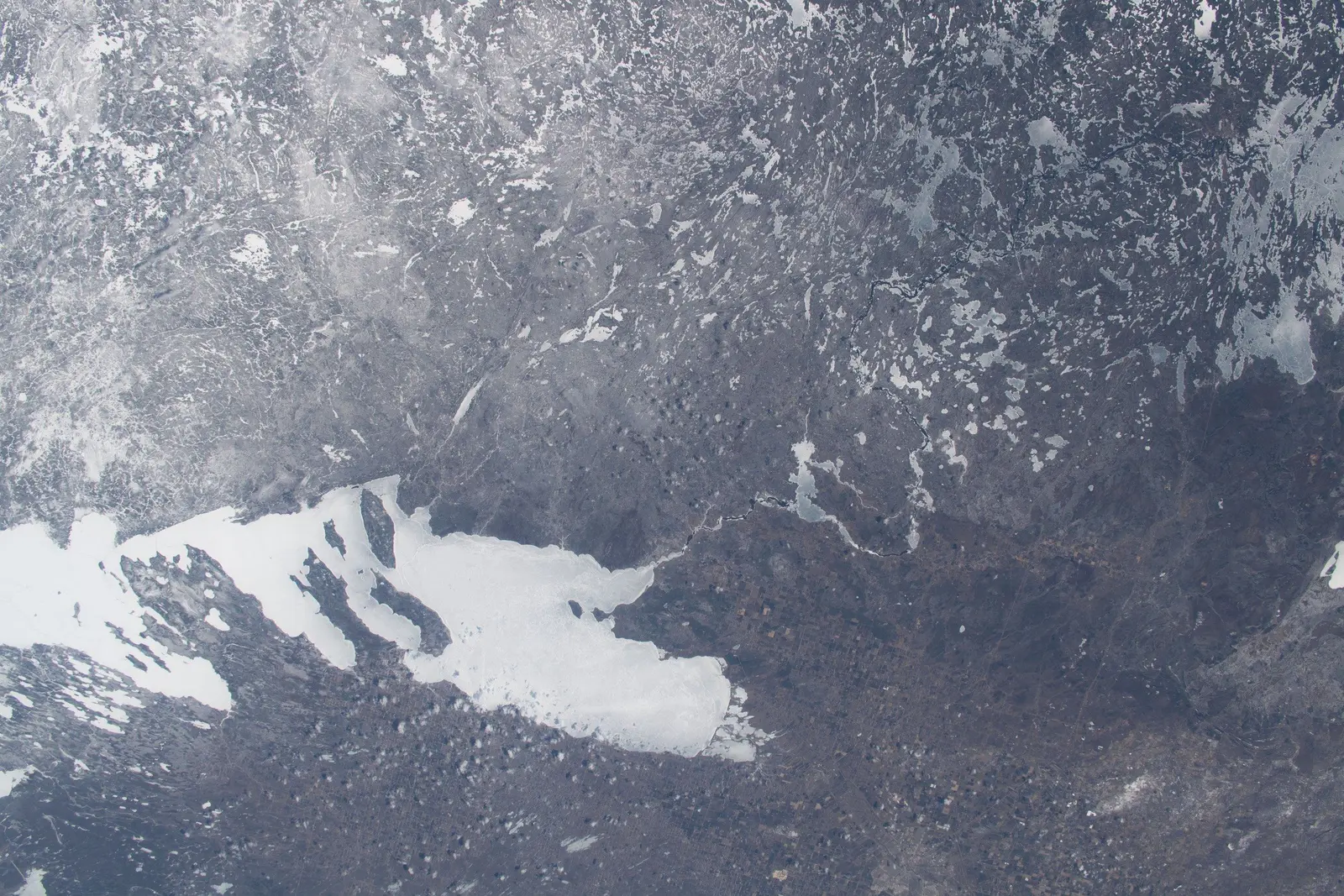
- Lake Winnipeg south basin, 15 Apr 2020 · Image courtesy of the Earth Science and Remote Sensing Unit, NASA JSC, ISS062-E-151466. US federal government work (NASA) · Source
- C-GAUN at Gimli after the landing, 1983. Copyright holder, via Wikimedia Commons, CC BY-SA 3.0, cropped for this page · Source
- Film stills, loops, maps and diagrams: from the Backstory Report film, drawn from the sources above.
Every archive picture in the film, with its rights (8)
- Red River delta and Lake Winnipeg, 13 Jun 2009 · Image courtesy of the Earth Science and Remote Sensing Unit, NASA JSC, ISS020-E-9380. US federal government work (NASA) · Record
- Lake Winnipeg south basin, 25 Sep 2023, W. Liang · NASA Earth Observatory, Landsat 9 (USGS). US federal government work (NASA, USGS Landsat) · Record
- Lake Winnipeg, 3 Aug 2020 · NASA GSFC, MODIS. US federal government work (NASA) · Record
- Lake Winnipeg, 12 Oct 2004, J. Descloitres · NASA GSFC, MODIS. US federal government work (NASA) · Record
- Lake Winnipeg south basin, 15 Apr 2020 · Image courtesy of the Earth Science and Remote Sensing Unit, NASA JSC, ISS062-E-151466. US federal government work (NASA) · Record
- South end of Lake Winnipeg, 19 Apr 2026 · Image courtesy of the Earth Science and Remote Sensing Unit, NASA JSC, ISS074-E-494100. US federal government work (NASA) · Record
- Western Canada, 29 Sep 2017, J. Schmaltz · NASA GSFC, MODIS. US federal government work (NASA) · Record
- Lakes of Manitoba, 12 Sep 2023 · NASA GSFC, MODIS. US federal government work (NASA) · Record


Corrections. None to this case so far. Every correction is dated on the sources and corrections page.
Related cases
All cases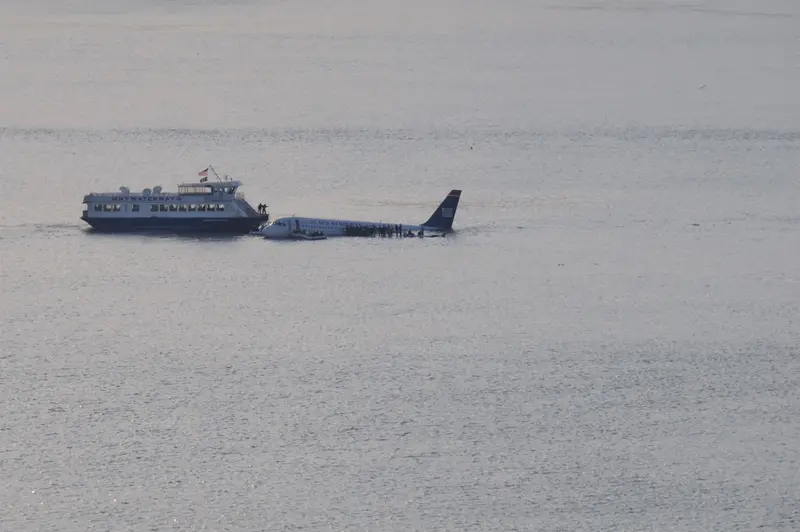
Both Engines Fail Over New York
Geese took both engines at 2,818 feet. Three and a half minutes later the crew put the airliner on the river.
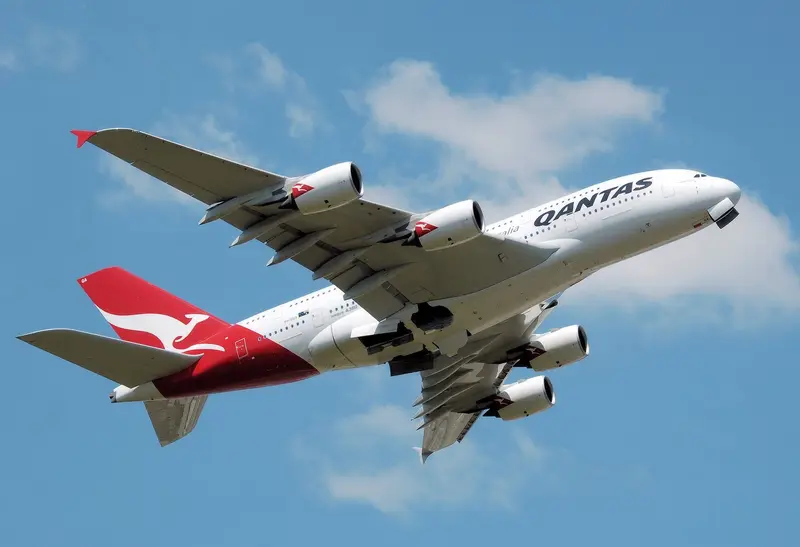
An A380 Engine Explodes After Takeoff
A turbine disc burst over Batam Island. Five pilots flew the damaged A380 back to Singapore.
Why the Mississippi Wants a New Path to the Sea
The Atchafalaya offers the Mississippi a route to the Gulf less than half as long. Gates have held it back since 1962.