 Backstory Report
AirCase File 005
Both Engines Fail Over New York
Geese took both engines at 2,818 feet. Three and a half minutes later the crew put the airliner on the river.
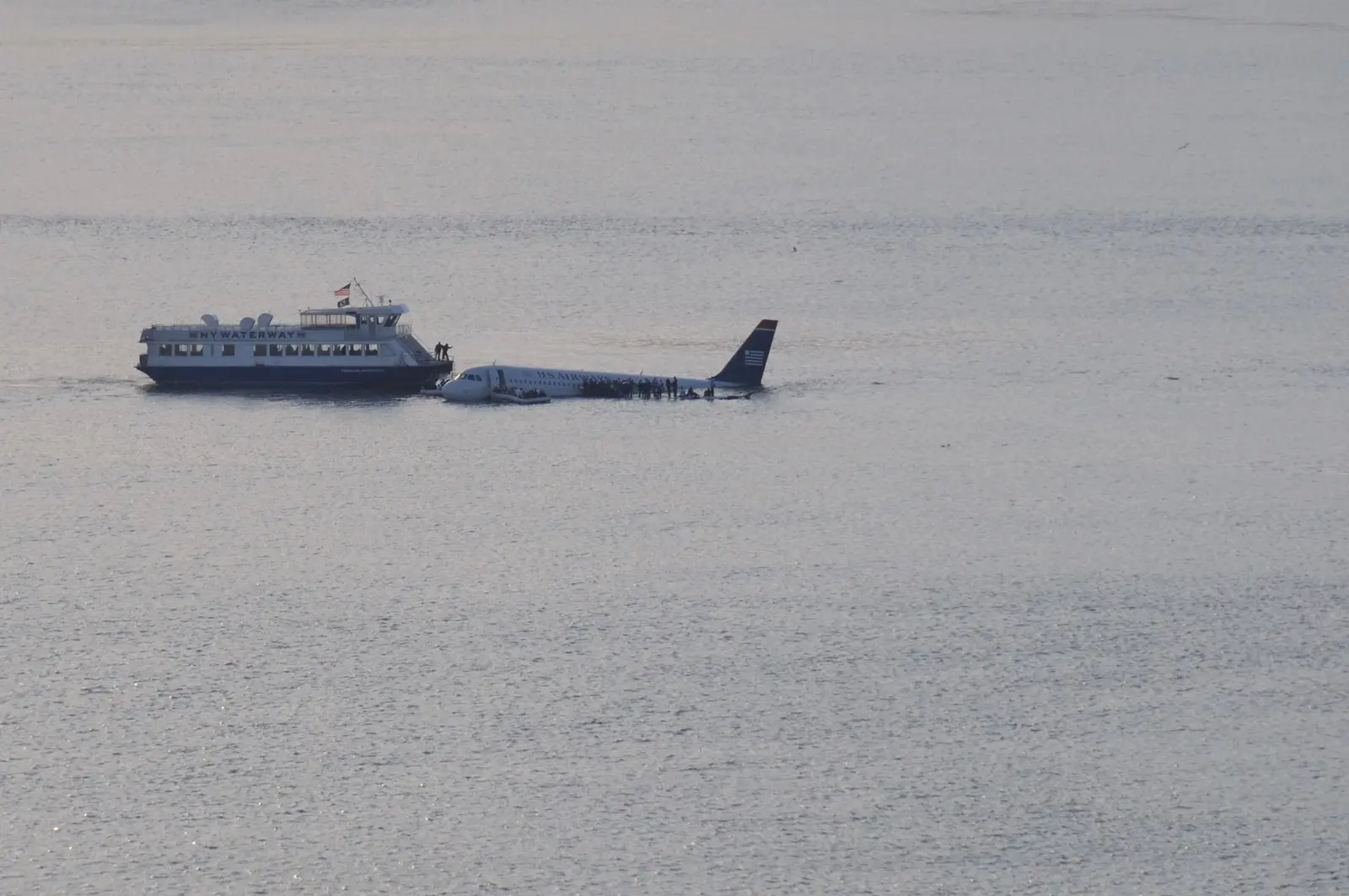

What the report found
- Large birds went into each engine and caused an almost total loss of thrust in both (p. 123). The DNA was Canada goose (p. 49).
- In simulator runs a turn back to LaGuardia worked only when it began at once; after a 35-second delay it failed (p. 50).
- The crew's decisions and teamwork, the cabin crew and the nearby boats all contributed to survival (p. 123).
The film
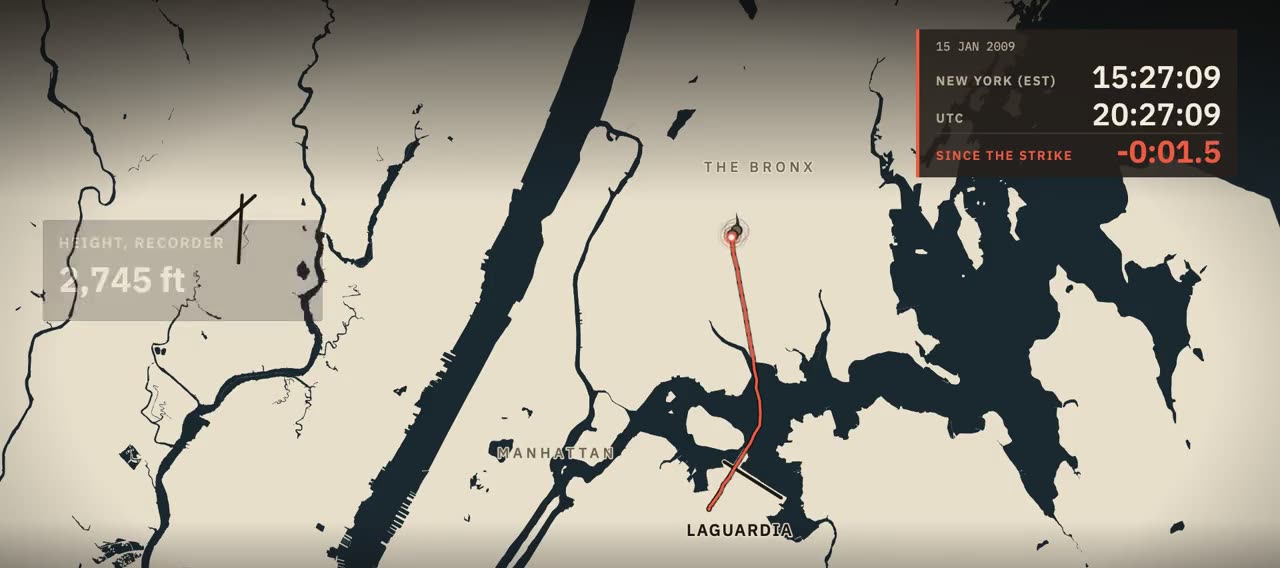
13 min. The film goes up on the Backstory Report channel; its full narration is the story below.
Birds at 2,818 feet over New York
Two thousand eight hundred feet above New York City. The airliner has been in the air for about a minute and a half. The captain says one word: "birds".
One second later, both engines lose almost all of their thrust. From here the flight has three and a half minutes left in the air. It ends on the Hudson River. All one hundred and fifty-five people on board survive.

Flight 1549 leaves LaGuardia for Charlotte
This film is built from the investigators' own record: the National Transportation Safety Board's accident report, adopted on the fourth of May, twenty ten, and the public docket behind it. The times, heights and words come from the flight data, the radar and the cockpit voice recorder.
“birds.”
p. 169, transcript, NTSB AAR-10/03, adopted 4 May 2010
On the fifteenth of January, twenty oh nine, US Airways flight fifteen forty-nine was cleared for take-off from runway four at LaGuardia, bound for Charlotte, North Carolina. The aircraft was an Airbus A three twenty, with two CFM fifty-six engines.
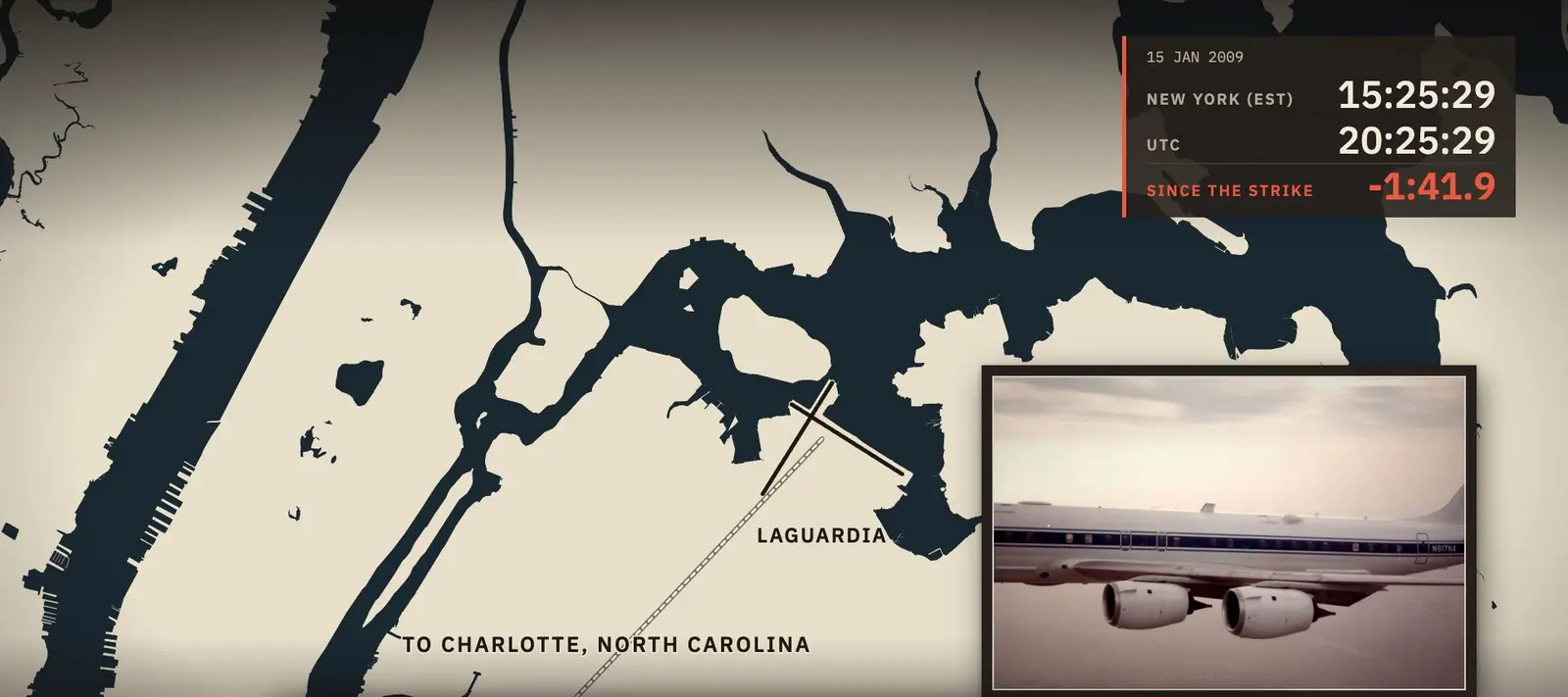
On board were one hundred and fifty passengers, including a child on a lap, and five crew.
In the left seat, the captain, fifty-seven, with nearly twenty thousand flying hours, more than four and a half thousand of them on this type. In the right seat, the first officer, forty-nine, with more than fifteen thousand hours. Thirty-seven of them were on the A three twenty. He had qualified on it fifteen days earlier. It was their first trip together.
Clear and cold: ten miles of visibility, minus six degrees Celsius. The first officer was flying.
Both engines lose almost all thrust
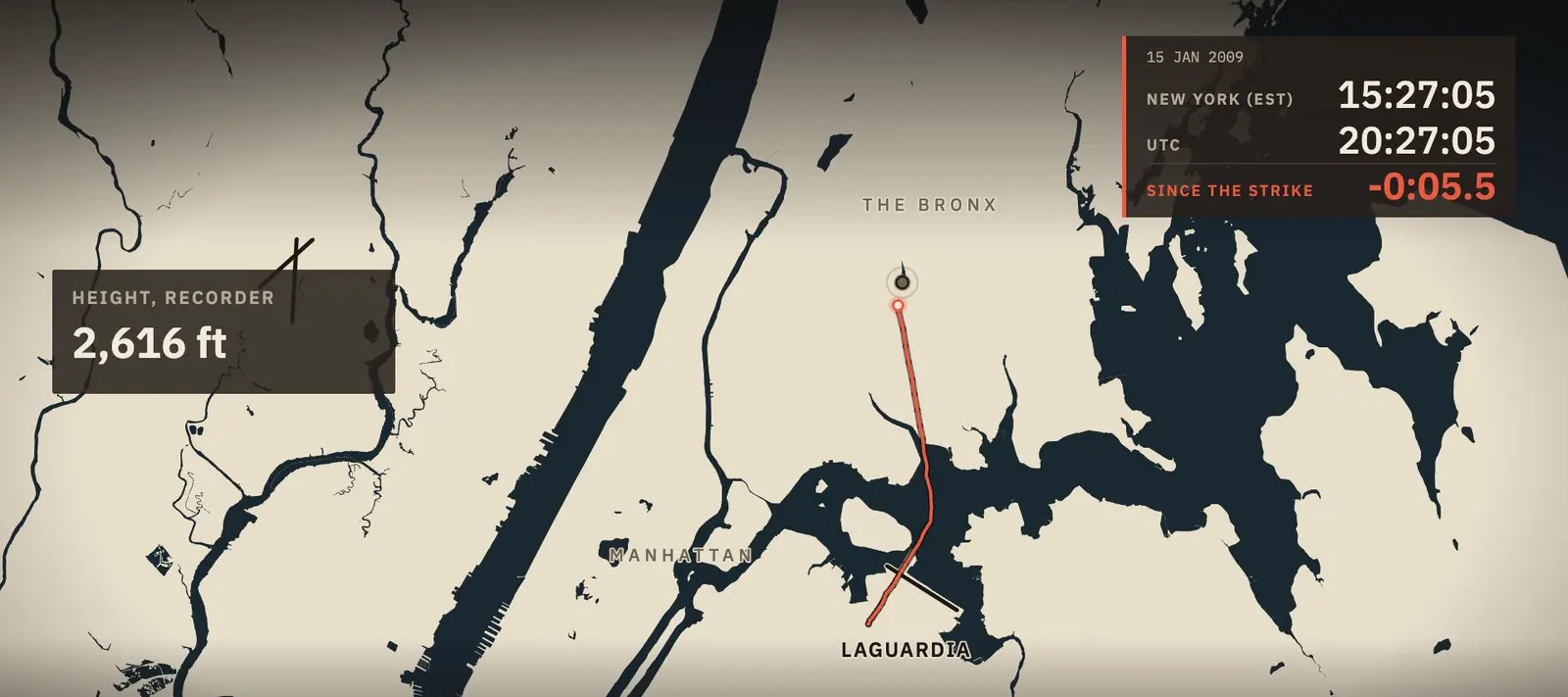
At three twenty-seven, climbing through about two and a half thousand feet, the aircraft's path crossed a string of unidentified radar echoes. They were not on the departure controller's screen. He had set it to show only echoes that behaved like aircraft, and the investigators found that choice appropriate.
At eleven seconds past three twenty-seven, the cockpit microphone records thumps, and a shudder. The left engine falls from eighty-two per cent fan speed to thirty-five. The right falls to fifteen. The first officer: "uh oh." The captain: "both of 'em rolling back".
Ten seconds after the strike, the captain starts the auxiliary power unit, an extra source of electrical power in the tail. It was a step the crew never reached on the checklist. The investigators found it kept a main source of electrical power available, and with it the flight control protections, one of which prevents a stall.
Two seconds later: "my aircraft." The captain takes the controls. The first officer takes the checklist.
With almost no thrust, the aircraft still climbs for a few seconds, trading speed for height. Nineteen seconds after the strike it tops out at about three thousand and sixty feet.
The 211 seconds, and the minutes either side
Every entry is a time in the report or its docket, with the page. Scroll on; the dot follows the recorded track.
- 15:24:54-2:17.4 from the strike · tower
Cleared for take-off, runway 4
Cactus fifteen forty nine runway four, cleared for takeoff.
report p. 165 (transcript) - 15:27:11+0:00.0 from the strike · cockpit microphone
Thumps and shudder: the bird strike, 2,818 ft AGL (report p. 2)
[sound of thump/thud(s) followed by shuddering sound]
report p. 169 (transcript); docket 85 p. 5 - 15:27:23+0:11.8 from the strike · captain
"my aircraft": the captain takes control
my aircraft.
report p. 170 (transcript) - 15:27:32+0:21.5 from the strike · captain
Mayday call to departure: "hit birds", "we're turning back towards LaGuardia" (the mayday words were not transmitted, p. 2 fn 7)
hit birds ... we're turning back towards LaGuardia.
report p. 172 (transcript) - 15:28:05+0:53.6 from the strike · departure
Offers runway 13 at LaGuardia
do you want to try to land runway one three?
report p. 174 (transcript) - 15:28:10+0:59.2 from the strike · captain
"we're unable. we may end up in the Hudson"
we're unable. we may end up in the Hudson.
report p. 174 (transcript) - 15:29:21+2:09.6 from the strike · departure
Offers runway 1 at Teterboro
you can land runway one at Teterboro.
report p. 178 (transcript) - 15:29:28+2:16.6 from the strike · captain
"we're gonna be in the Hudson", descending through 700 ft
we're gonna be in the Hudson.
report p. 179 (transcript); docket 85 p. 18 - 15:29:49+2:37.6 from the strike · aircraft
Flap lever to CONF 2, through 270 ft
report p. 47 - 15:30:43+3:31.6 from the strike · aircraft
Touchdown on the Hudson: 125 KCAS, pitch 9.5 degrees, 12.5 ft/s
report p. 48 - 15:34:40+7:28.6 from the strike · rescue
First vessel arrives
report p. 42
The full record, 55 entries
- 15:24:54 Cleared for take-off, runway 4 report p. 165 (transcript)
- 15:25:04 Take-off roll begins (about) docket 85 p. 18
- 15:25:40 Lift-off (about 36 s after the roll began; crew arithmetic) docket 85 p. 18
- 15:25:51 Tells departure the aircraft is at 700 ft climbing to 5,000 report p. 1
- 15:27:01 Path crosses a string of unidentified primary returns, about 2,500 ft report p. 27
- 15:27:10 "birds" report p. 169 (transcript)
- 15:27:11 Thumps and shudder: the bird strike, 2,818 ft AGL (report p. 2) report p. 169 (transcript); docket 85 p. 5
- 15:27:14 "uh oh" report p. 170 (transcript)
- 15:27:15 "both of 'em rolling back" report p. 170 (transcript)
- 15:27:21 Starts the APU report p. 170 (transcript)
- 15:27:23 "my aircraft": the captain takes control report p. 170 (transcript)
- 15:27:28 Calls for the QRH, loss of thrust on both engines report p. 172 (transcript)
- 15:27:30 Highest point, about 3,060 ft, about 185 KCAS report p. 47
- 15:27:32 Mayday call to departure: "hit birds", "we're turning back towards LaGuardia" (the mayday words were not transmitted, p. 2 fn 7) report p. 172 (transcript)
- 15:27:42 Turn left heading 220 report p. 172 (transcript)
- 15:27:50 Begins Part 1 of the Engine Dual Failure checklist report p. 173 (transcript)
- 15:28:01 Both thrust levers to idle (FDR) report p. 55
- 15:28:02 Optimum relight 300 kt: "we don't have that" report p. 173 (transcript)
- 15:28:05 Offers runway 13 at LaGuardia report p. 174 (transcript)
- 15:28:10 About 1,650 ft, 210 KCAS report p. 47
- 15:28:10 "we're unable. we may end up in the Hudson" report p. 174 (transcript)
- 15:28:30 Rolls out of the left turn on a heading of about 230, through 1,450 ft docket 85 p. 18
- 15:28:31 Offers left traffic for runway 31 report p. 175 (transcript)
- 15:28:35 "unable" report p. 175 (transcript)
- 15:28:46 Runway 4 available report p. 176 (transcript)
- 15:28:49 Asks about New Jersey: "maybe Teterboro?" report p. 176 (transcript)
- 15:28:53 Crash phone activated report p. 44
- 15:28:55 Teterboro is off the right side report p. 176 (transcript)
- 15:29:03 "yes" to trying Teterboro report p. 177 (transcript)
- 15:29:11 PA to the cabin: "brace for impact" report p. 178 (transcript)
- 15:29:14 First of 15 ground proximity alerts report p. 3 fn 12; p. 178
- 15:29:21 Offers runway 1 at Teterboro report p. 178 (transcript)
- 15:29:25 "we can't do it" report p. 179 (transcript)
- 15:29:27 Left engine master switch OFF (on again about 10 s later) report p. 55
- 15:29:28 "we're gonna be in the Hudson", descending through 700 ft report p. 179 (transcript); docket 85 p. 18
- 15:29:44 "no relight" report p. 180 (transcript)
- 15:29:45 Calls for the flaps report p. 181 (transcript)
- 15:29:49 Flap lever to CONF 2, through 270 ft report p. 47
- 15:29:53 Radar contact lost docket 85 p. 24
- 15:30:16 Brief climb tops out at 360 ft docket 85 p. 19
- 15:30:17 "got flaps two, you want more?" report p. 184 (transcript)
- 15:30:19 "no lets stay at two" report p. 184 (transcript)
- 15:30:21 "got any ideas?" report p. 184 (transcript)
- 15:30:23 "actually not" report p. 184 (transcript)
- 15:30:36 Progressive aft sidestick begins, about 100 ft radio altitude report p. 48
- 15:30:38 "we're gonna brace" report p. 185 (transcript)
- 15:30:40 Last of the 15 ground proximity alerts report p. 3 fn 12
- 15:30:41 Sidestick at its aft limit (16 degrees) until touchdown report p. 48
- 15:30:43 Touchdown on the Hudson: 125 KCAS, pitch 9.5 degrees, 12.5 ft/s report p. 48
- 15:30:43 End of the cockpit voice recording report p. 185 (transcript)
- 15:30:58 Left overwing exits open report p. 41
- 15:31:06 Door 1L open report p. 41
- 15:31:11 Door 1R open report p. 41
- 15:34:40 First vessel arrives report p. 42
- 15:54:43 Last vessel departs with the last rescued passengers report p. 42
LaGuardia, Teterboro or the Hudson
Twenty-two seconds after the strike, the captain calls departure control: "hit birds", "we're turning back towards LaGuardia". His first words did not get through. Another pilot was transmitting at the same moment.
“we're unable. we may end up in the Hudson.”
p. 174, transcript, NTSB AAR-10/03, adopted 4 May 2010
The controller turns the flight left, back toward the airport, and tells the tower to stop departures.
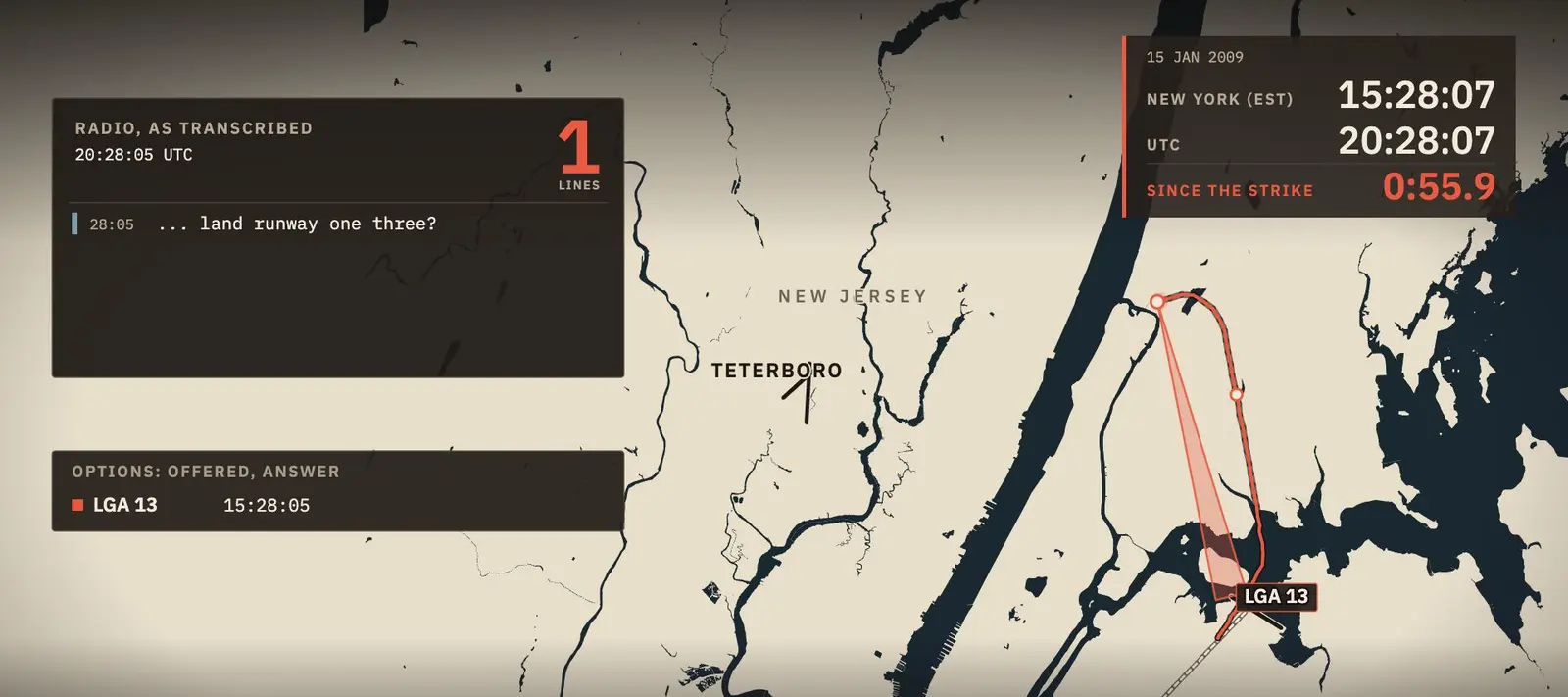
The first officer works from the engine dual failure checklist, three pages long. Airbus had written it for a failure above twenty thousand feet. It had not considered a checklist for a failure this low.
One early step asks for three hundred knots, the best speed for restarting the engines in flight. The first officer reads it out: "we don't have that".
Fifty-four seconds after the strike, the controller offers runway one three at LaGuardia. Five seconds later the captain answers: "we're unable. we may end up in the Hudson". The aircraft has already lost about fourteen hundred feet.
The captain later told investigators that turning back would have been an "irrevocable choice": if they fell short, there would be nowhere else to go. A direct return would also have crossed Manhattan.
About a hundred seconds after the strike, at thirteen hundred feet, he asks what lies to the right: "maybe Teterboro?" The controller offers runway one there. Thirty-five seconds after his question: "we can't do it". The captain's later words: "too far away, too low, and too slow".
Three seconds after that, at about seven hundred feet: "we're gonna be in the Hudson". The river was the one place, in his words, "long enough, smooth enough, and wide enough".
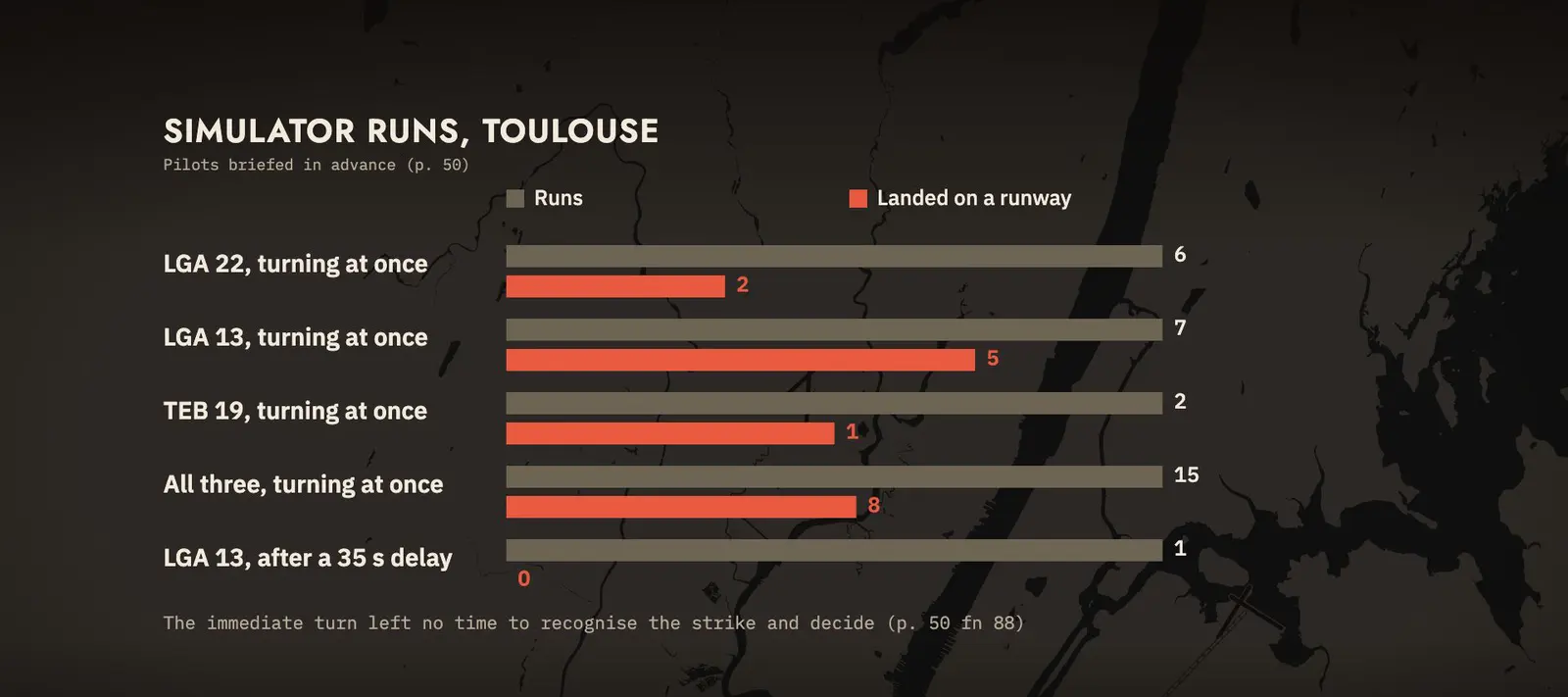
Investigators later flew the problem in simulators in Toulouse. Pilots briefed in advance, who turned for a runway the instant the thrust went, made it in eight of fifteen runs. The one run that allowed thirty-five seconds to understand the failure and decide did not make it. The board found the river gave the highest chance of survival.
Five places to come down. Pick one to see what the record says.
Both engines had almost no thrust. Between 15:28:05 and 15:29:21 the controller offered three LaGuardia runways and one at Teterboro. The captain named the river five seconds after the first offer.
Choose a place on the left.
LaGuardia, runway 13
- Height, recorder
- about 1,770 ft
- Distance
- 5.92 nm
- After the strike
- 54 s
15:28:05 · departuredo you want to try to land runway one three?
p. 174
15:28:10.6 · the answerwe're unable. we may end up in the Hudson.
p. 174
LaGuardia, runway 31
- Height, recorder
- about 1,410 ft
- Distance
- 6.31 nm
- After the strike
- 1 min 20 s
15:28:31 · departureits gonna be left traffic for runway three one.
p. 175
15:28:35 · the answerunable.
p. 175
LaGuardia, runway 4
- Height, recorder
- about 1,090 ft
- Distance
- 5.53 nm
- After the strike
- 1 min 35 s
15:28:46 · departurerunway four's available if you wanna make left traffic to runway four.
p. 176
15:28:49.9 · the answerI'm not sure we can make any runway. uh what's over to our right anything in New Jersey maybe Teterboro?
p. 176
Teterboro, runway 1
- Height, recorder
- about 850 ft
- Distance
- 4.32 nm
- After the strike
- 2 min 10 s
15:29:21 · departureturn right two eight zero, you can land runway one at Teterboro.
p. 178
15:29:25 · the answerwe can't do it.
p. 179
The Hudson River
- Height, recorder
- about 1,640 ft
- Distance
- 7.59 nm
- After the strike
- 59 s
15:28:10.6 · captainwe're unable. we may end up in the Hudson.
p. 174
15:29:28 · captain, the decisionwe're gonna be in the Hudson.
p. 179
Afterwards, in the simulator
Airbus engineering simulator runs for the investigation, turning back at once after the strike (report p. 50). The pilots were briefed in advance; an immediate turn left no time to recognise the strike and decide.
| Runway | When the turn began | Runs | Landed |
|---|---|---|---|
| LGA 22 | immediate turn | 6 | 2 |
| LGA 13 | immediate turn | 7 | 5 |
| TEB 19 | immediate turn | 2 | 1 |
| all three, immediate | immediate turn | 15 | 8 (53 percent) |
| LGA 13 | after a 35-second delay | 1 | 0 |
No restart could bring the thrust back
All this time, the first officer had been working the restart steps: engine switches off, a wait, and on again. The engines were still turning, and still burning fuel. But in each one, birds had broken guide vanes at the front of the core, and the pieces had damaged the compressors behind them. No restart could bring the thrust back. The restart attempts took thirty to forty seconds. Nothing on the flight deck could tell the crew the engines were beyond restarting.
Two minutes after the strike, the captain speaks to the cabin: "this is the Captain brace for impact". Ninety-two seconds remain.
Fifteen alerts on the way down the river
The aircraft is over the river now, heading south between New Jersey and Manhattan. The warning system calls "too low, terrain", and then "pull up", again and again. Fifteen alerts in eighty-five seconds.
“got any ideas?”
p. 184, transcript, NTSB AAR-10/03, adopted 4 May 2010
At about two hundred and seventy feet the flaps go to position two. The first officer asks, "you want more?" The captain: "no lets stay at two". The checklist's water landing page called for position three. The crew never reached that page. The board found the choice of two reasonable.
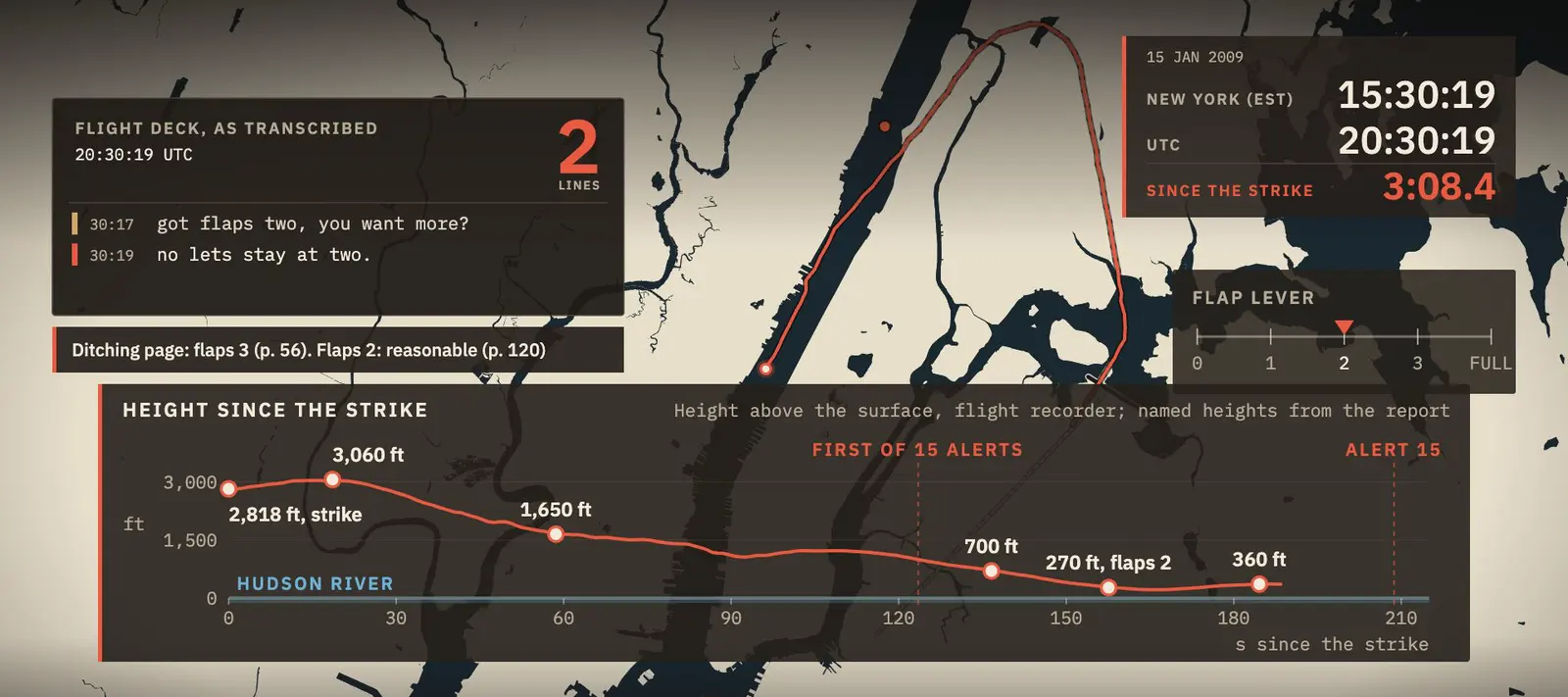
Twenty-two seconds before touchdown, the captain asks: "got any ideas?" The first officer: "actually not".
In the last two hundred feet, the speed sits fifteen to nineteen knots below the speed that keeps a set margin above the stall. In the last two seconds the captain pulls the sidestick fully back. The protection system will not let the wing stall, and it limits how far the nose comes up.
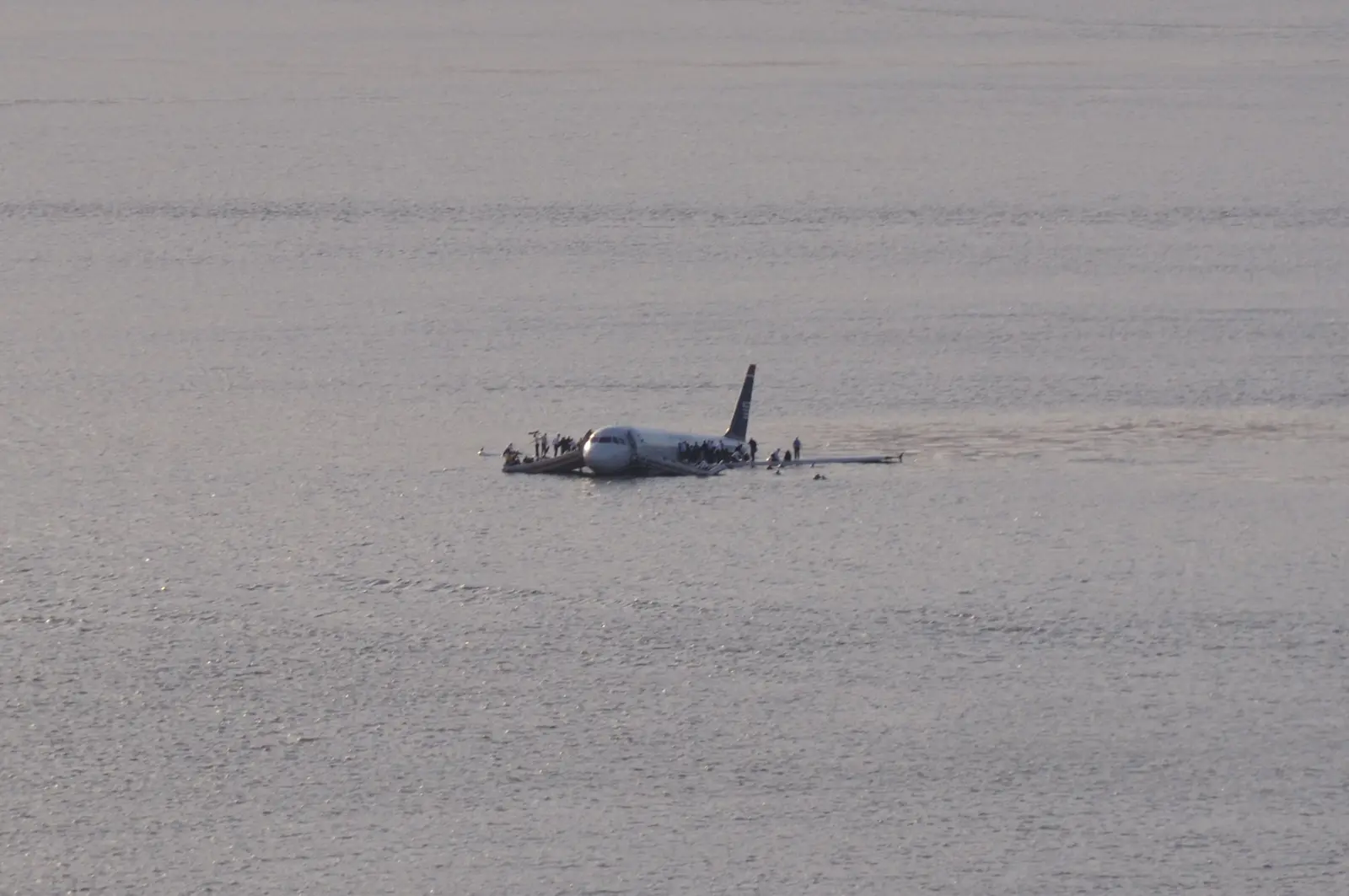
At three thirty and forty-three seconds, the aircraft touches the Hudson, near the ferry terminal at Weehawken, New Jersey. One hundred and twenty-five knots, nose up nine and a half degrees. Three and a half minutes after the birds. The board calls it a ditching: a landing on water that the crew chose, with the aircraft under control.

The ditching, 3 1/2 minutes after the birds
When the A three twenty was certified for landing on water, the certification assumed a descent of three and a half feet a second, with engine power available. Flight fifteen forty-nine came down at twelve and a half.
The impact broke the lower rear of the fuselage, and the river came in at the back.
Out through the front doors and onto the wings
Fifteen seconds after touchdown, the left overwing exits were open. The front doors followed, twenty-three and twenty-eight seconds after. Water was coming in at the back, so the rear slides could not be used. The flight attendants sent people forward, to the front doors and the wings.
This aircraft happened to carry equipment for flights far out over water, though this route did not need it. About sixty-four people used its two front slides as rafts.
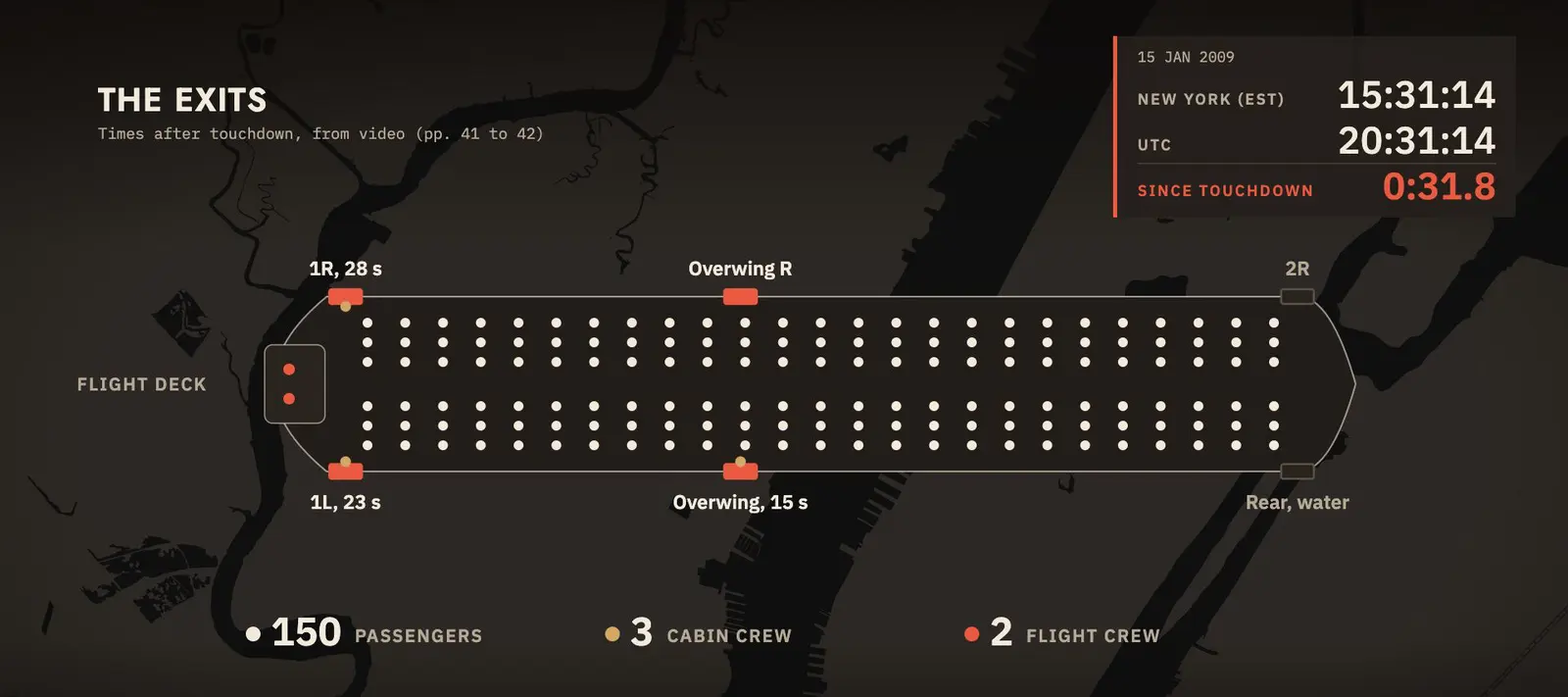
The river was five degrees Celsius. The air was below freezing. The captain and first officer checked that no one was left in the cabin, then stepped onto the front left raft.
The first ferry arrived about four minutes after touchdown. Seven ferries, a fire department boat and two Coast Guard boats took people off the wings and rafts. The last boat with the last passengers left twenty-four minutes after touchdown. Five people were seriously hurt: one flight attendant and four passengers. No one died.

Every usable DNA sample was Canada goose
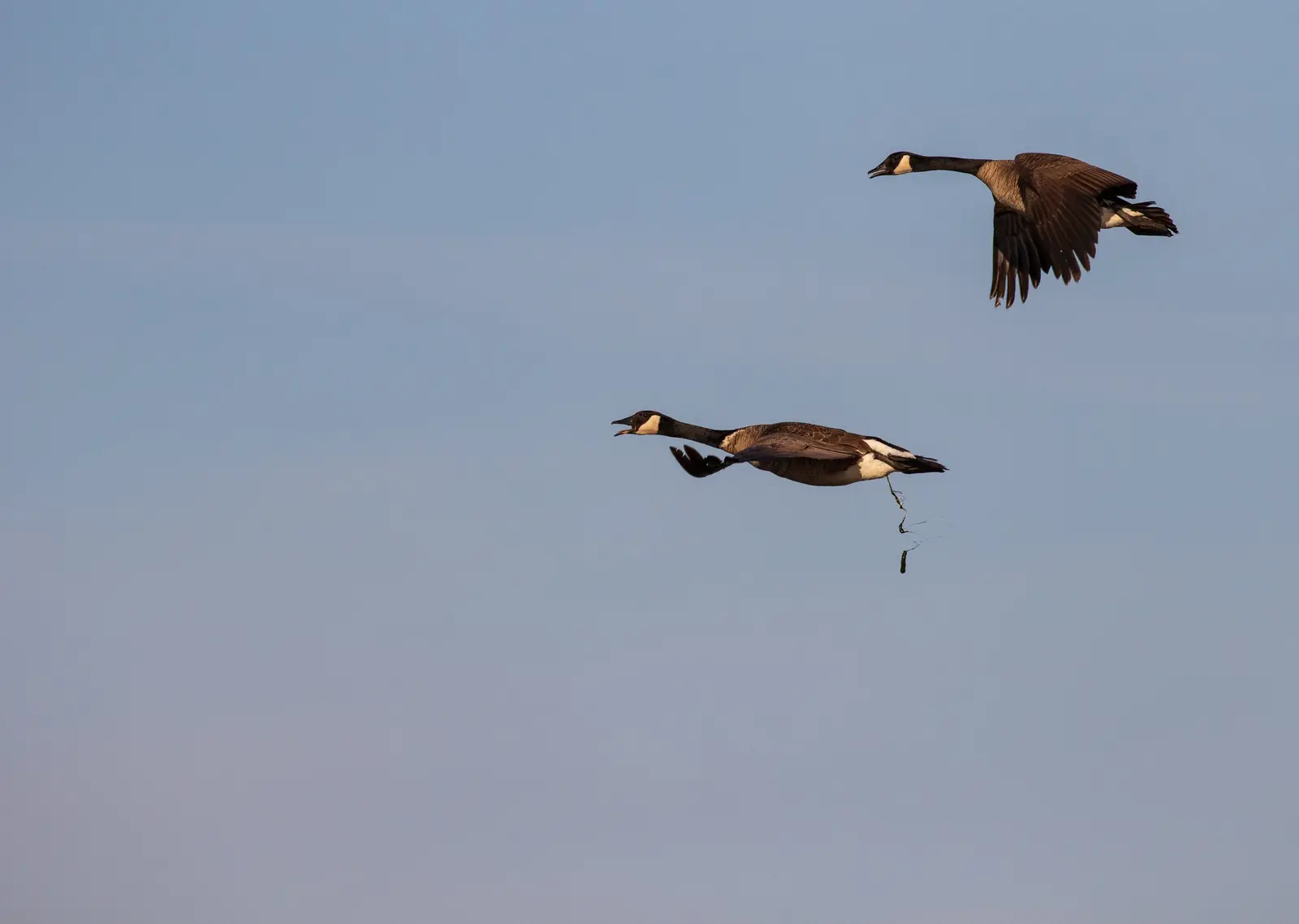
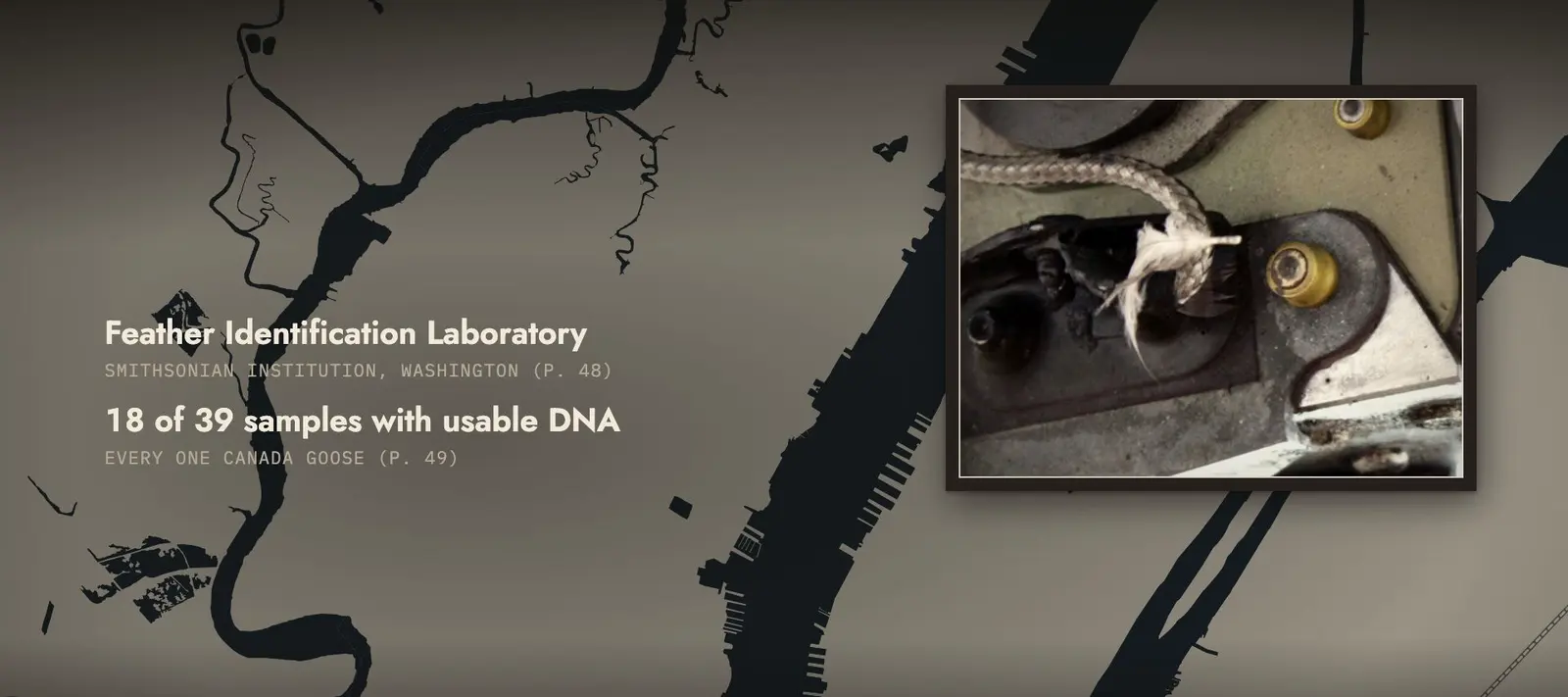
Investigators sent feathers and tissue from the engines and the airframe to the Smithsonian Institution's feather identification laboratory. Every sample with usable DNA matched one species: the Canada goose.
“the decision-making of the flight crewmembers and their crew resource management during the accident sequence;”
p. 123, NTSB AAR-10/03, adopted 4 May 2010
There were male and female geese in the left engine, and only male remains in the right. Each engine took in at least two birds of about eight pounds.
Chemical tests found the feathers resembled geese that migrate, and differed from the geese that live around New York all year.
The engine's certification tests used a single four pound bird, and volleys of birds weighing one and a half pounds. The board found these geese well beyond those standards, in size and in number.
Of the large airliners destroyed by bird strikes since nineteen sixty, ninety-three per cent were hit below about five hundred feet, near an airport. This one was at almost three thousand feet. The board concluded that a bird strike does not need to be typical to be hazardous.
The probable cause, in the board's words
The board's finding of probable cause, in its own words: "the ingestion of large birds into each engine, which resulted in an almost total loss of thrust in both engines and the subsequent ditching on the Hudson River." "Contributing to the fuselage damage and resulting unavailability of the aft slide rafts were one, the Federal Aviation Administration's approval of ditching certification without determining whether pilots could attain the ditching parameters without engine thrust, two, the lack of industry flight crew training and guidance on ditching techniques, and three, the captain's resulting difficulty maintaining his intended airspeed on final approach due to the task saturation resulting from the emergency situation."
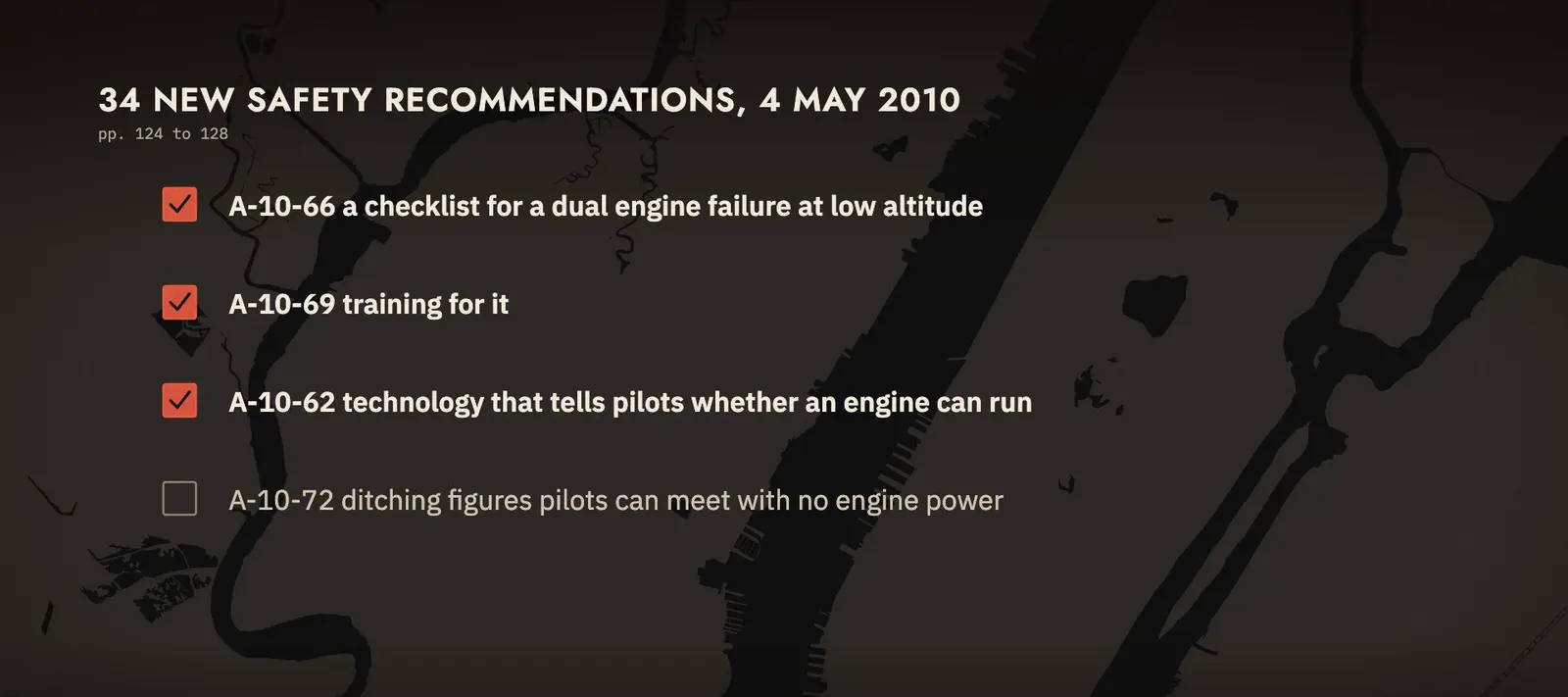
With its report, the board made thirty-four new safety recommendations. Among them: a checklist for a dual engine failure at low altitude, and training for one. Technology that tells pilots whether an engine can still run. And proof that pilots can meet an aircraft's figures for a water landing with no engine power, without exceptional skill or strength.
The board named four things that contributed to survival: the crew's decisions and teamwork, the rafts this aircraft happened to carry, the cabin crew's evacuation, and rescuers close at hand. It also wrote that the success mostly came from fortunate circumstances: good visibility, calm water, a very experienced crew, and boats nearby.
Lift-off to the river: about five minutes. The strike to the river: three and a half minutes, from three thousand feet.
All one hundred and fifty-five people on board lived. Source: National Transportation Safety Board.
What changed after
- With its report the NTSB made 34 new safety recommendations, A-10-62 to A-10-95.pp. 124 to 128, NTSB AAR-10/03, adopted 4 May 2010
- A checklist for a dual engine failure at low altitude, and training for it (A-10-66, A-10-69).pp. 124 to 125, NTSB AAR-10/03, adopted 4 May 2010
- Technology that tells pilots whether an engine can still run (A-10-62).p. 124, NTSB AAR-10/03, adopted 4 May 2010
- Proof that pilots can meet an aircraft's figures for a water landing with no engine power, without exceptional skill or strength (A-10-72).p. 125, NTSB AAR-10/03, adopted 4 May 2010
Fact check and sources
The National Transportation Safety Board, probable cause:
“The National Transportation Safety Board determines that the probable cause of this accident was the ingestion of large birds into each engine, which resulted in an almost total loss of thrust in both engines and the subsequent ditching on the Hudson River.”
NTSB AAR-10/03, adopted 4 May 2010, p. 123
Checked against the record
- 15:27:10 The captain, one second before the strike.
birds.
p. 169, transcript, NTSB AAR-10/03, adopted 4 May 2010 - 15:28:10 Answer to the offer of runway 13.
we're unable. we may end up in the Hudson.
p. 174, transcript, NTSB AAR-10/03, adopted 4 May 2010 - 15:30:21 Twenty-two seconds before touchdown.
got any ideas?
p. 184, transcript, NTSB AAR-10/03, adopted 4 May 2010 - Survival What the Board credited first.
the decision-making of the flight crewmembers and their crew resource management during the accident sequence;
p. 123, NTSB AAR-10/03, adopted 4 May 2010
Sources
- National Transportation Safety Board, Loss of Thrust in Both Engines After Encountering a Flock of Birds and Subsequent Ditching on the Hudson River, US Airways Flight 1549, Airbus A320-214, N106US, Weehawken, New Jersey, January 15, 2009, Aircraft Accident Report NTSB/AAR-10/03, adopted 4 May 2010
- NTSB public docket DCA09MA026: item 85, Aircraft Performance Study, 10 Dec 2009 (radar track, Table 1a, p. 22); items 88 and 89, flight data recorder report and data; item 101, Wildlife Factors report, 15 May 2009; item 103, feather laboratory analysis
- Courtesy: National Transportation Safety Board. No footage or photograph of the event is used; every map and diagram is redrawn from the report and the docket.
- Map data: US Census Bureau TIGER/Line 2024; FAA runway data (NASR, effective 29 Oct 2026); USGS GNIS place names; Natural Earth.
Times and heights pp. 1 to 3 and 47 to 48; cockpit voice recorder transcript, Appendix B, pp. 132 to 185; simulator runs p. 50; feathers and birds pp. 49 and 80; findings pp. 119 to 122; probable cause p. 123; recommendations pp. 124 to 128.
Pictures on this page
- Flight 1549 and a ferry on the Hudson, 15 Jan 2009. Photo: Greg L, CC BY 2.0, cropped for this page · Source
- Flight 1549 on the Hudson, 15 Jan 2009. Photo: Greg L, CC BY 2.0, cropped for this page · Source
- Canada geese, Big Stone refuge, Minnesota, 2024, M. Budd · USFWS, public domain. Public domain (US federal government work) · Source
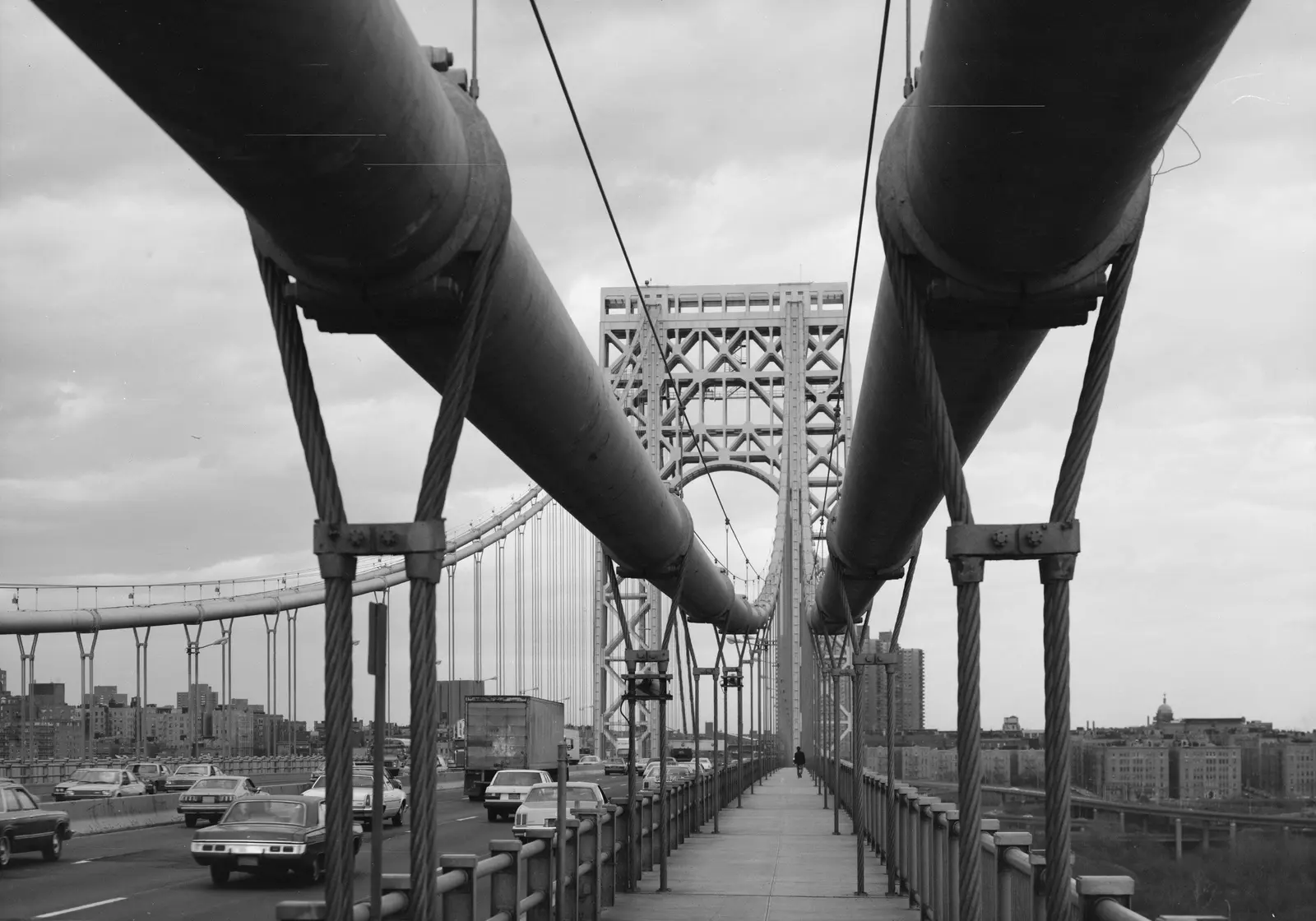
- The Hudson at the George Washington Bridge, APR 1986, Jet Lowe · HAER NY-129-28, Library of Congress. Public domain (US federal government work) · Source
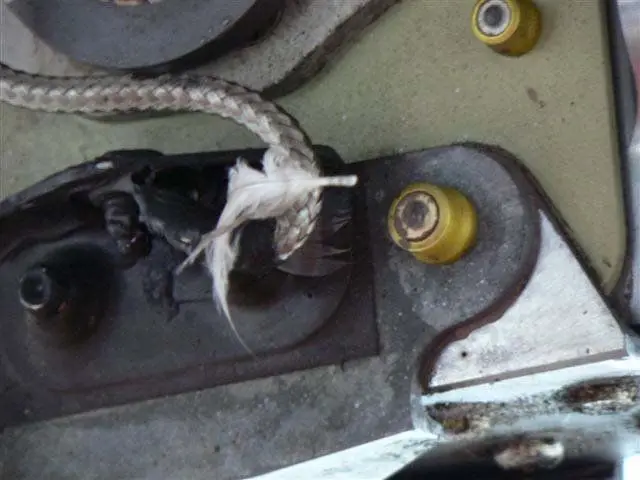
- Feather remains in the left wing flap track, 2009 · Courtesy: National Transportation Safety Board. Public domain (US federal government work) · Source
- Film stills, loops, maps and diagrams: from the Backstory Report film, drawn from the sources above.
Every archive picture in the film, with its rights (18)
- New York in winter, Landsat 8, false colour, 28 JAN 2026 · NASA Earth Observatory, M. Garrison, USGS data. Public domain (US federal government work) · Record
- New York City, Landsat 9, 22 AUG 2025 · NASA Earth Observatory, W. Liang, USGS data. Public domain (US federal government work) · Record
- LaGuardia airport diagram, May 2013 · FAA. Public domain (US federal government work) · Record
- The Hudson at the George Washington Bridge, APR 1986, Jet Lowe · HAER NY-129-28, Library of Congress. Public domain (US federal government work) · Record
- The George Washington Bridge, OCT 1991, Jet Lowe · HAER NY-129-78, Library of Congress. Public domain (US federal government work) · Record
- Canada geese, Big Stone refuge, Minnesota, 2024, M. Budd · USFWS, public domain. Public domain (US federal government work) · Record
- Geese in flight, Big Stone refuge, Minnesota, 2024, M. Budd · USFWS, public domain. Public domain (US federal government work) · Record
- NTSB Aircraft Accident Report AAR-10/03, adopted 4 May 2010 · Courtesy: National Transportation Safety Board. Public domain (US federal government work) · Record
- CVR transcript, NTSB AAR-10/03, p. 170 · Courtesy: National Transportation Safety Board. Public domain (US federal government work) · Record
- Flight path plan view, NTSB docket DCA09MA026, item 85 · Courtesy: National Transportation Safety Board. Public domain (US federal government work) · Record
- Feather remains in the left wing flap track, 2009 · Courtesy: National Transportation Safety Board. Public domain (US federal government work) · Record
- Fan blades with feather remains, 2009 · Courtesy: National Transportation Safety Board. Public domain (US federal government work) · Record
- The left engine at teardown, Feb 2009 · Courtesy: National Transportation Safety Board. Public domain (US federal government work) · Record
- New York in winter from the space station, 13 FEB 2026 · NASA/Chris Williams, iss074e0315625. Public domain (US federal government work) · Record
- A turbofan engine, not this type, NASA Lewis, 1979 · NASA via U.S. National Archives, NAID 17475341. Public domain (US federal government work) · Record
- CFM56 engines on NASA's DC-8, not this aircraft, 2000, J. Ross · NASA Dryden, EC00-0347-004. Public domain (US federal government work) · Record
- Ice on the Hudson, upriver, 31 JAN 2011 · U.S. Coast Guard. Public domain (US federal government work) · Record
- Manhattan and the Hudson from the space station, OCT 2021 · NASA, iss065e484582. Public domain (US federal government work) · Record


Corrections. None to this case so far. Every correction is dated on the sources and corrections page.
Related cases
All cases
A 767 Runs Out of Fuel Mid-Flight
The gauges were blank, so the fuel was measured by hand. One factor turned litres into the wrong unit.
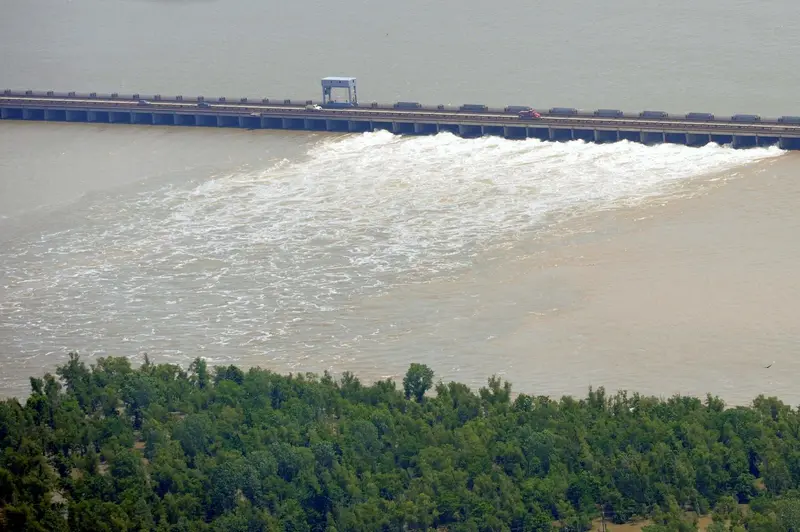
Why the Mississippi Wants a New Path to the Sea
The Atchafalaya offers the Mississippi a route to the Gulf less than half as long. Gates have held it back since 1962.
An A380 Engine Explodes After Takeoff
A turbine disc burst over Batam Island. Five pilots flew the damaged A380 back to Singapore.