 Backstory Report
RailCase File 001
Why You Couldn't Take One Train Across Australia
The colonies laid three widths of track. Until 1962 no passenger train ran through from Sydney to Melbourne.
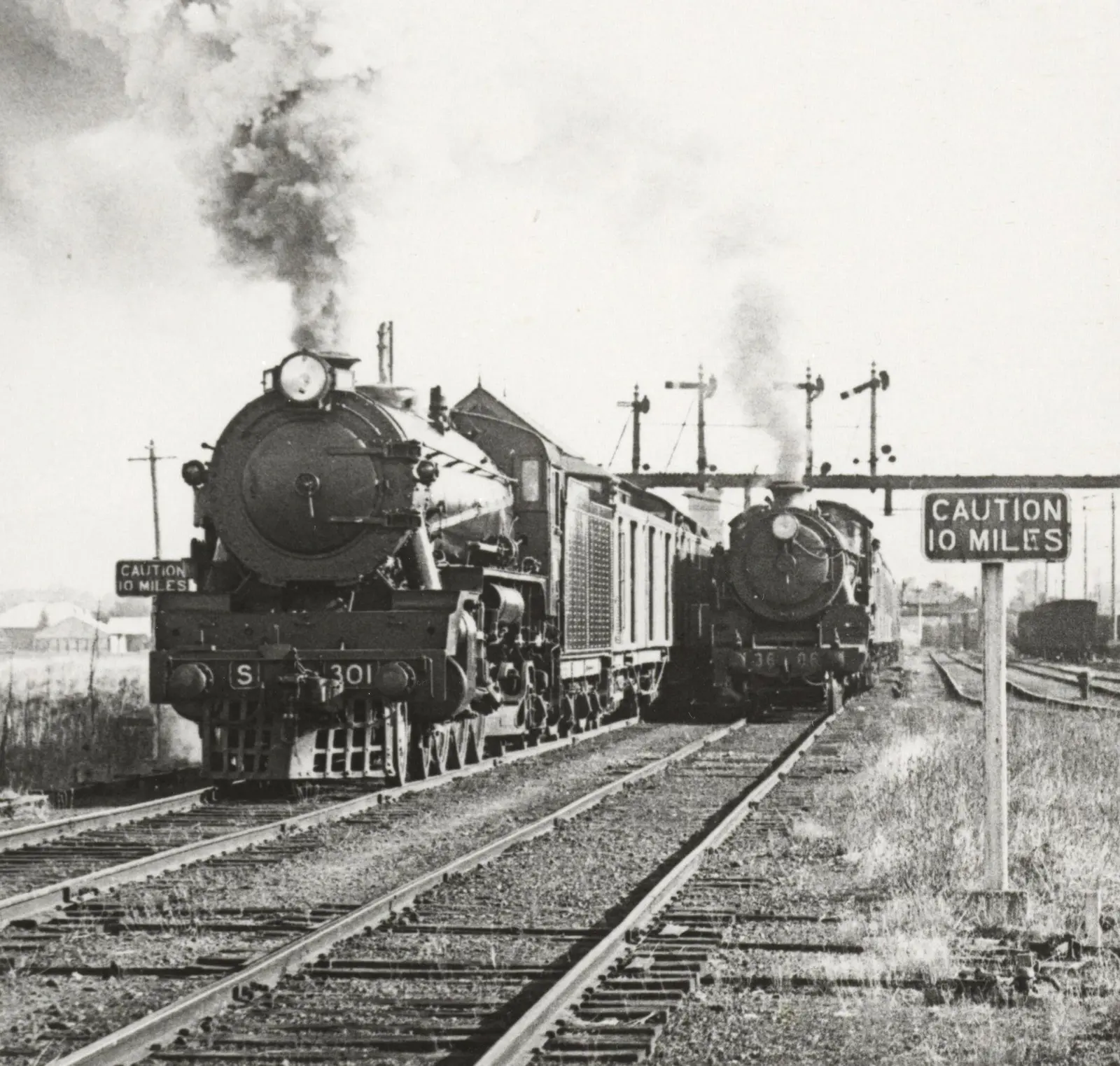
What the record shows
- The colonies built to three widths of track: 1,600, 1,435 and 1,067 millimetres.
- Where two gauges met, at towns like Albury, passengers and goods changed trains until the lines were joined.
- Today about 56 per cent of the open network is standard gauge, 35 per cent narrow and 8 per cent broad (BITRE, 2024).
The film

13 min. The film goes up on the Backstory Report channel; its full narration is the story below.
Until 1962 no train ran through to Melbourne
Until 1962, no passenger train ran straight through from Sydney to Melbourne. The rails were different widths, and every traveller changed trains at the border, often at night.
Three widths of track, laid by colonies that were meant to agree.
A gauge is the width between the rails
A rail gauge is the distance between the inside edges of the two rails. Wheels are built to one gauge. A wagon from one gauge cannot run on another.
“routed out of their snug beds by lantern-light in the morning”
Following the Equator, ch. XIV
Australia uses three. Standard gauge, 1,435 millimetres. Broad gauge, 1,600 millimetres. And narrow gauge, 1,067 millimetres. In the old measures: four feet eight and a half inches, five feet three, and three feet six.
Today, a train can run between the mainland capitals on one gauge. Getting there took about a hundred and fifty years. The trouble began with a handful of letters in the 1840s and 1850s.
An Irish engineer chose the Irish gauge
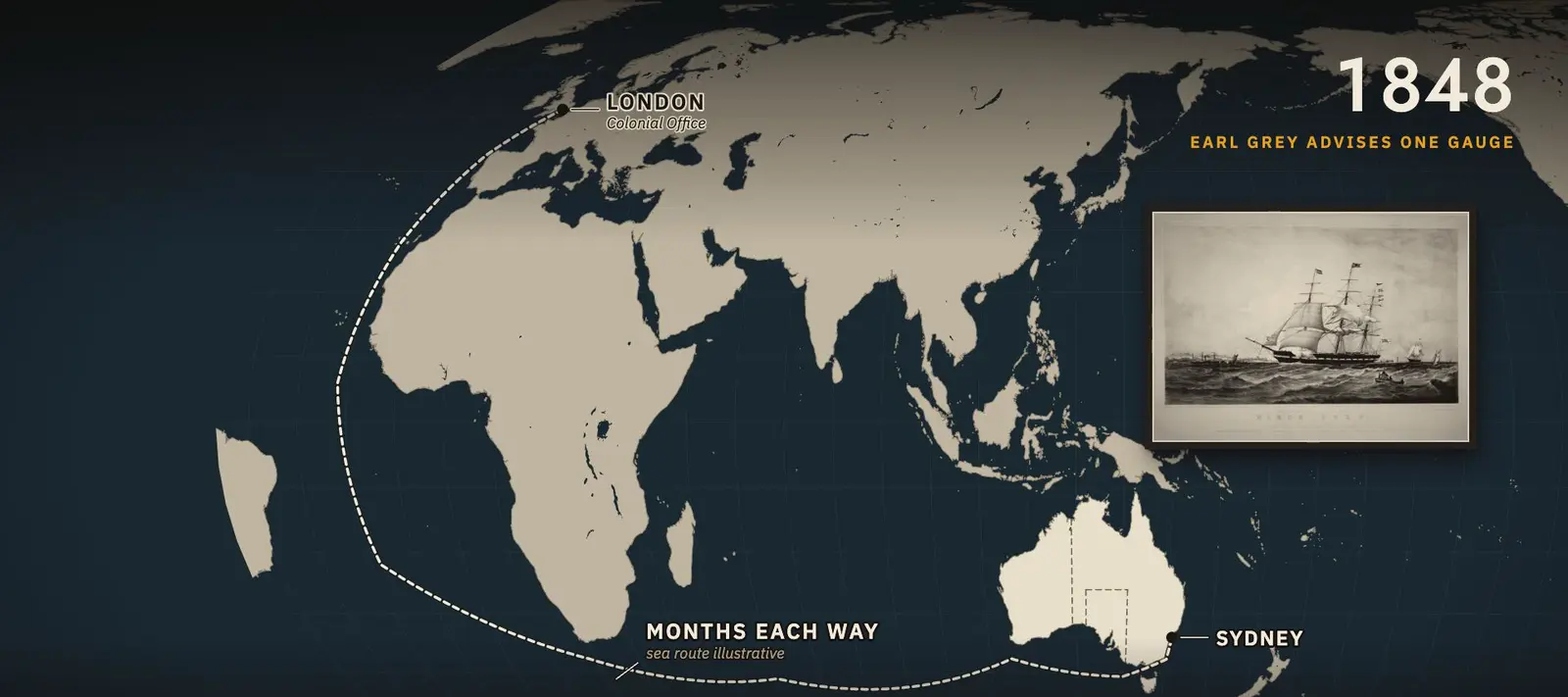
In 1848, Britain's Colonial Secretary, Earl Grey, advised the Governor of New South Wales to use one gauge across the colonies. His choice was the British standard, four feet eight and a half.
Letters between London and Sydney went by ship, and took months each way. A question and its answer could take the better part of a year. Decisions on the ground moved faster than decisions in London.
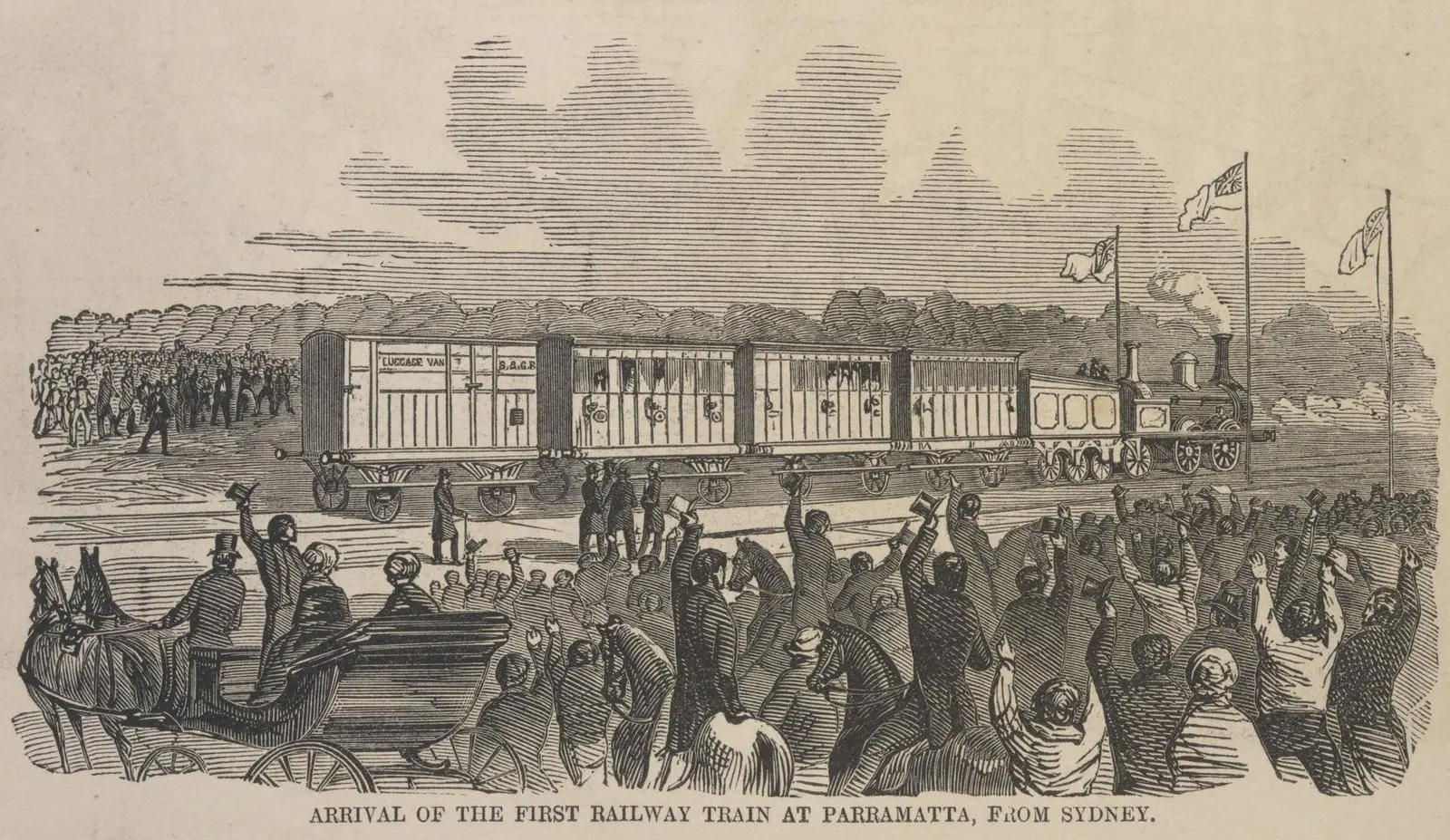
In Sydney, the Sydney Railway Company was planning a line to Parramatta. In 1849 it hired an Irish engineer, Francis Webb Sheilds, as chief engineer.
Sheilds knew Irish railways. In 1850 he persuaded the company to choose the Irish gauge of five feet three. The colony passed the request to London.
Then the money ran short. Late in 1850 the company cut salaries, and Sheilds resigned with three of his staff. His gauge stayed. London agreed to it in 1851, and in July 1852 New South Wales made it law.
The company's next chief engineer, James Wallace, arrived from Britain in 1852. Within weeks, he recommended the British standard. In January 1853, the government told the company the five foot three law would be repealed. New South Wales had changed its mind.
Melbourne's broad gauge order had sailed
Victoria had separated from New South Wales in 1851. In February 1853, Sydney sent a memo south, saying it was switching to standard gauge.
Timing mattered. The Melbourne and Hobson's Bay Railway Company was waiting to send its order for locomotives and carriages to England by ship. In early April 1853, Victoria's government said it would stay with five feet three. Days later, the order sailed.
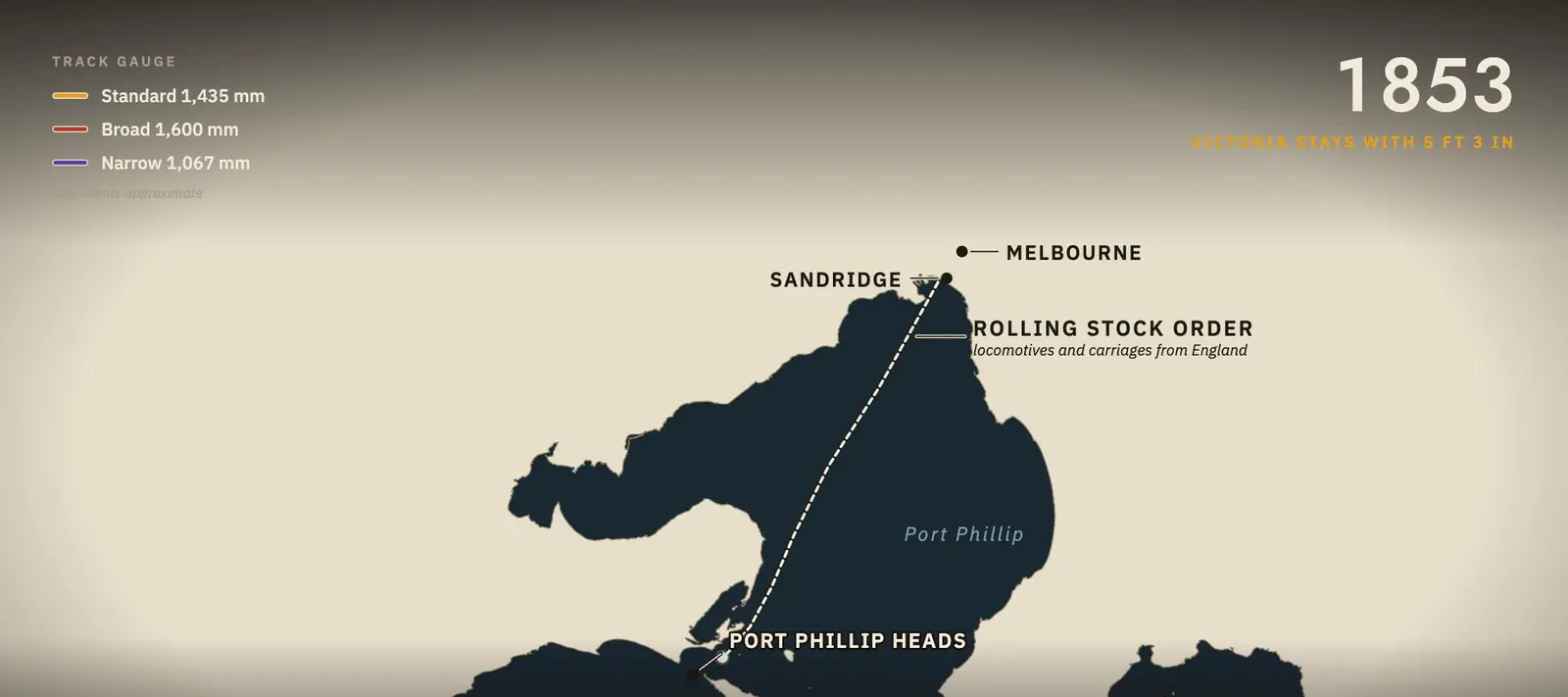
In July 1853, Victoria told New South Wales it would keep the broad gauge. It even asked London to make Sydney reverse.
On 12 September 1854, Australia's first steam railway opened in Melbourne. About four kilometres, from Flinders Street to Sandridge, on broad gauge.
On 26 September 1855, Sydney's first line opened to Parramatta Junction, on standard gauge. In 1856, South Australia opened its first steam railway, from Adelaide to Port Adelaide. Like Victoria, it used broad gauge.
The gap could still have been closed cheaply. In 1857, the New South Wales engineer John Whitton proposed converting Sydney's line to broad gauge. There were only a few dozen kilometres of track and a handful of engines. The proposal went nowhere.
Whitton went on to build the New South Wales network on standard gauge instead. By 1889, the colony had more than 3,000 kilometres of it.
Queensland built a cheaper narrow gauge
Then a third width arrived. In 1865, Queensland opened its first line, from Ipswich to Grandchester, on three feet six. It was one of the first main lines anywhere built to a narrow gauge.
The reason was cost. Narrow track was cheaper and quicker to build, and it could take tighter curves through hills. For a young colony with a long coast and little money, that mattered more than matching its neighbours.
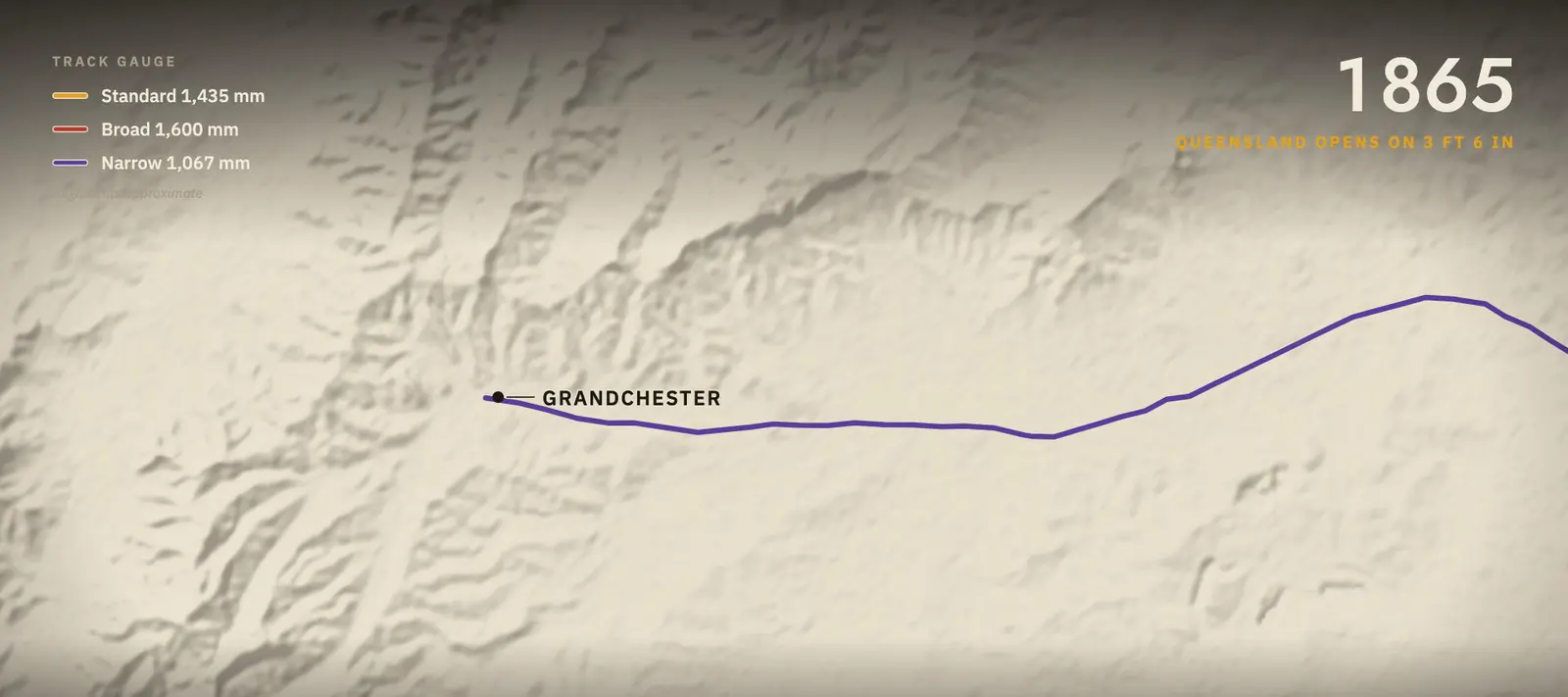
South Australia chose it too, from 1867, to build new lines more cheaply. So South Australia ended up running two gauges inside one colony.
Western Australia opened its first government line in 1879, from Geraldton to Northampton, also on three feet six. Tasmania opened on broad gauge in 1871, then converted to narrow in 1888.
For decades, none of this mattered much. Each colony's railway ran inland from its own ports. Between colonies, goods mostly went by sea, and borders had customs posts.
The Sydney and Melbourne lines met at Albury
In June 1883, the Sydney line and the Melbourne line met at Albury, on the Murray River. Two gauges, one station.
Albury was given a platform about 455 metres long, one of the longest in Australia. Passengers walked from one train to the other. Freight was unloaded from one set of wagons and reloaded into another.
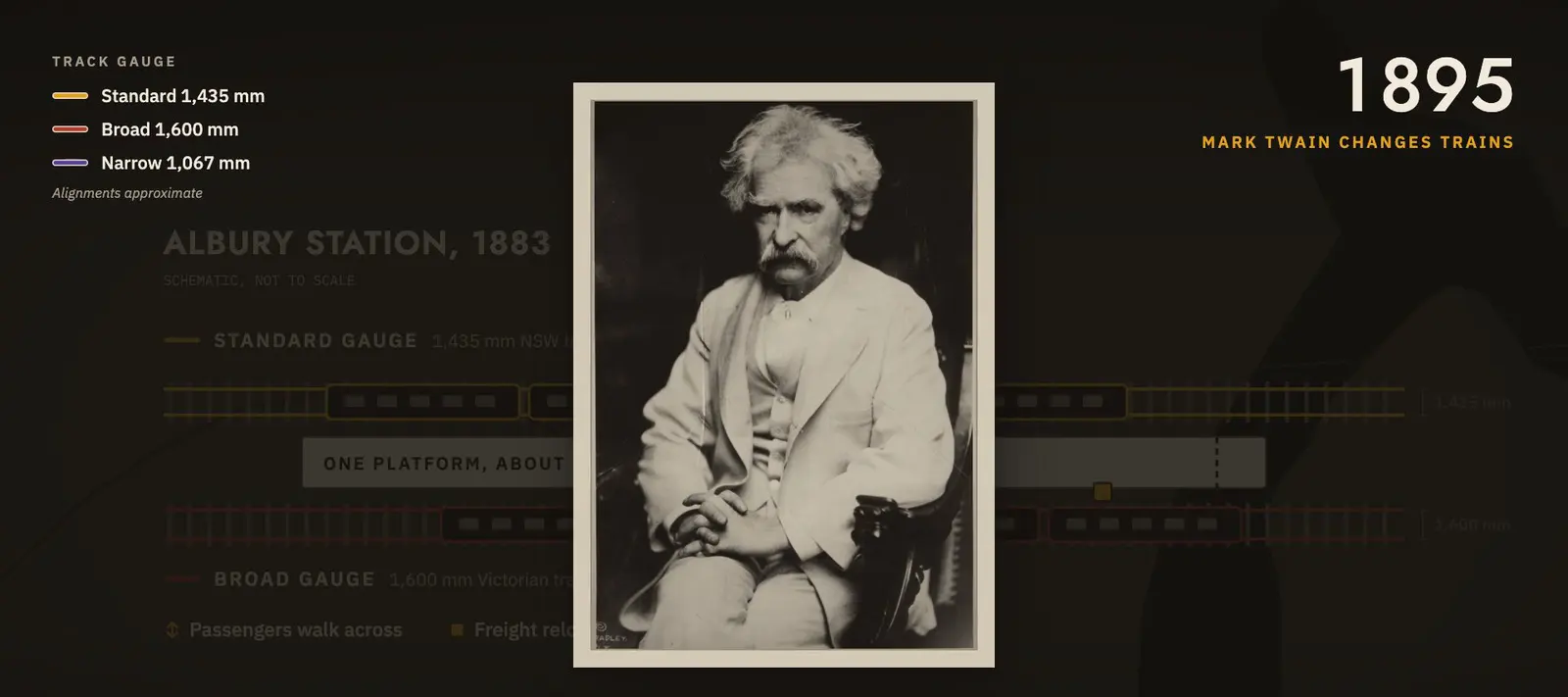
In 1895, the writer Mark Twain changed trains there. He wrote: "Think of the paralysis of intellect that gave that idea birth." One reason he was given was jealousy between the colonies.
Twain called the Sydney track the narrow one. It was the standard gauge, narrow only beside Victoria's broad.
In 1888, the Sydney line reached Queensland at Wallangarra. The station sat on the border, with one platform face for each gauge.
In South Australia, the broad gauge from Adelaide stopped at Terowie in 1880, and narrow gauge ran on north. Nearby Peterborough would later handle all three gauges in one yard.
A popular story says the gauges were chosen to slow down an invading army. The record does not support it. The choices came from engineers, costs and timing. Military complaints came later, in an 1889 report and again from Lord Kitchener two decades on.
When the colonies federated in 1901, the customs posts went. The breaks of gauge stayed.
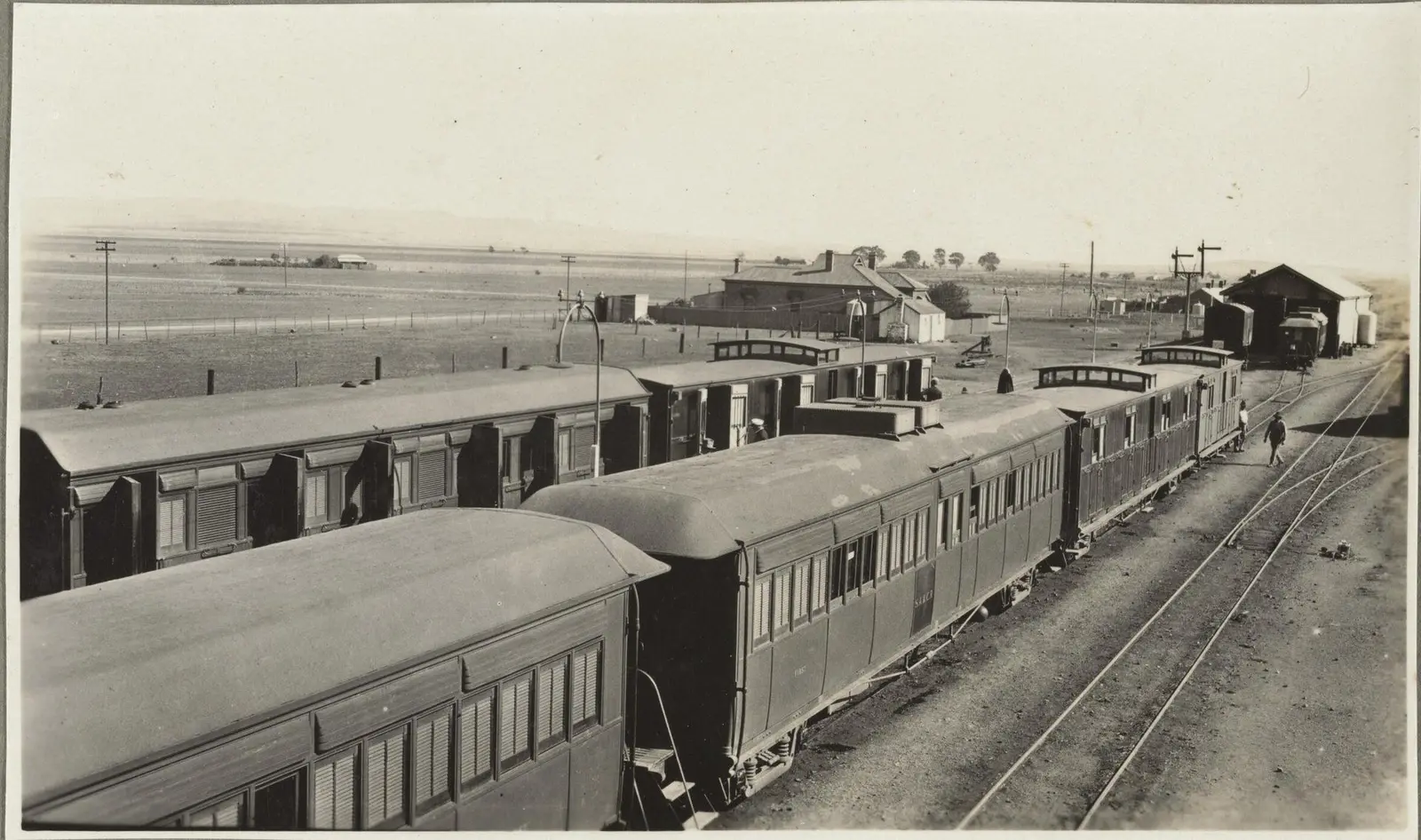
A standard gauge line crossed the desert
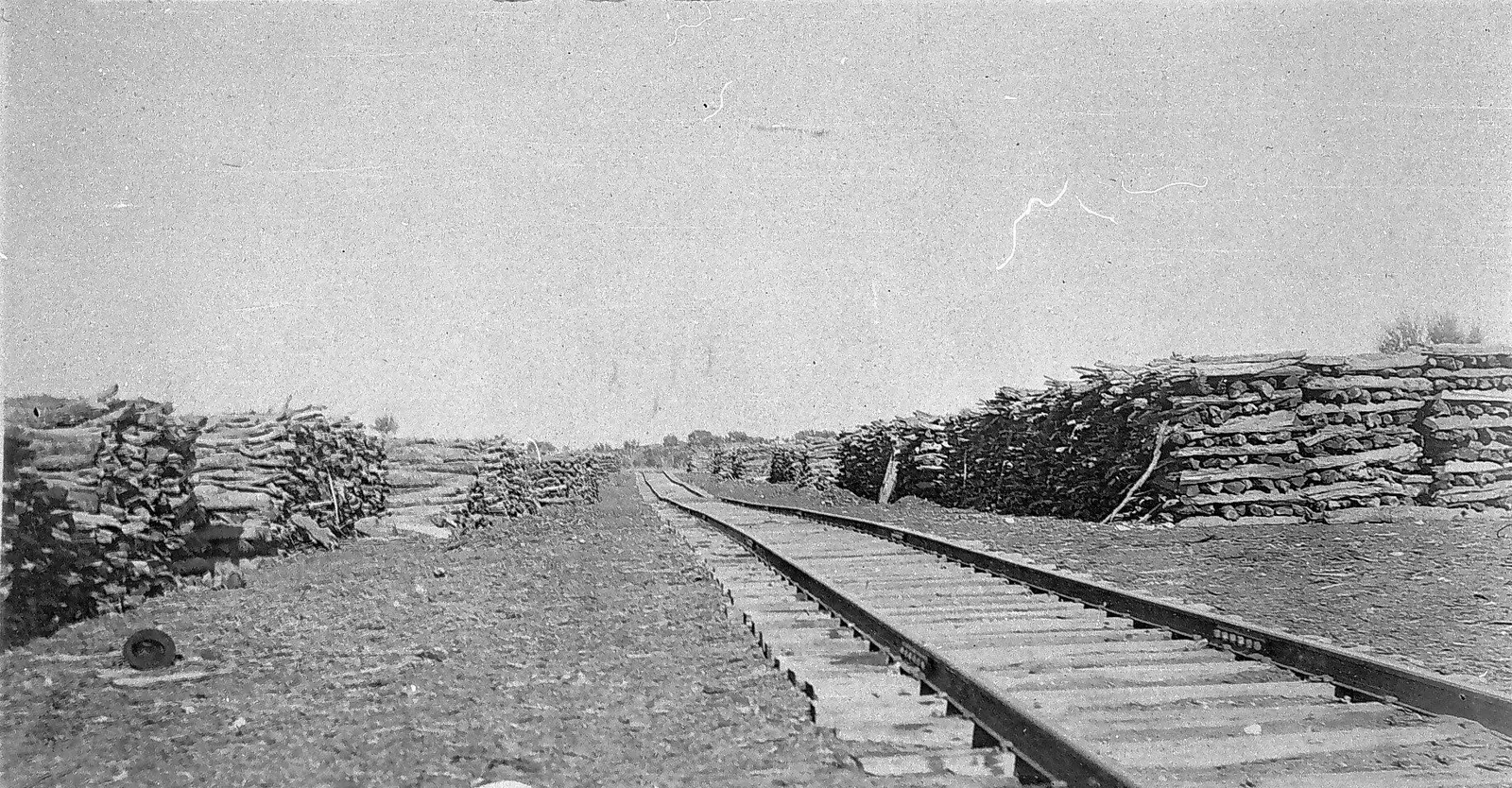
The new Commonwealth built a line to Western Australia. Work began at Port Augusta in September 1912. The two halves met at Ooldea on 17 October 1917.
The Trans-Australian Railway runs nearly 1,700 kilometres. It includes 478 kilometres of dead straight track across the Nullarbor Plain.
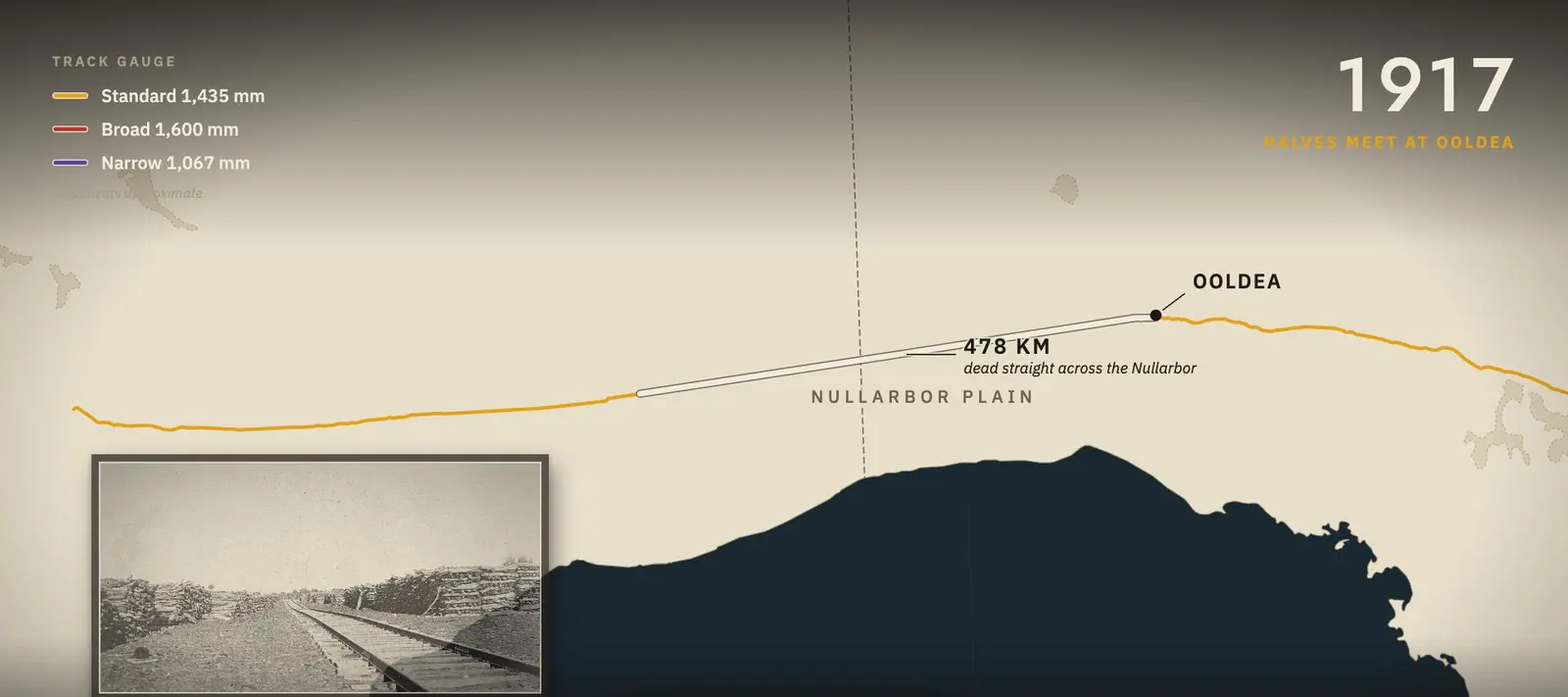
It was standard gauge. But at both ends it met narrow gauge lines. So the new railway created new breaks of gauge: at Kalgoorlie in the west, and at Port Augusta in the east.
A traveller from Brisbane to Perth had to change gauge several times along the way. The national railway had become a chain of transfer stations.
In 1921, a Royal Commission recommended standard gauge for the nation. Inventors kept proposing devices to get around the problem. None was adopted.
In November 1921, the Prime Minister and the state Premiers agreed to adopt standard gauge. Agreeing was quick. Paying for it took about another forty years.
In March 1942, General Douglas MacArthur changed trains at Terowie. There, at a break of gauge, he told reporters he would return to the Philippines.
The network was joined line by line
The fix came line by line. In 1930, standard gauge reached Brisbane from the south, via Kyogle.
In 1945, the Clapp Report costed a national conversion. In 1956, a committee in Canberra picked three trunk lines to start with. Albury to Melbourne was first.
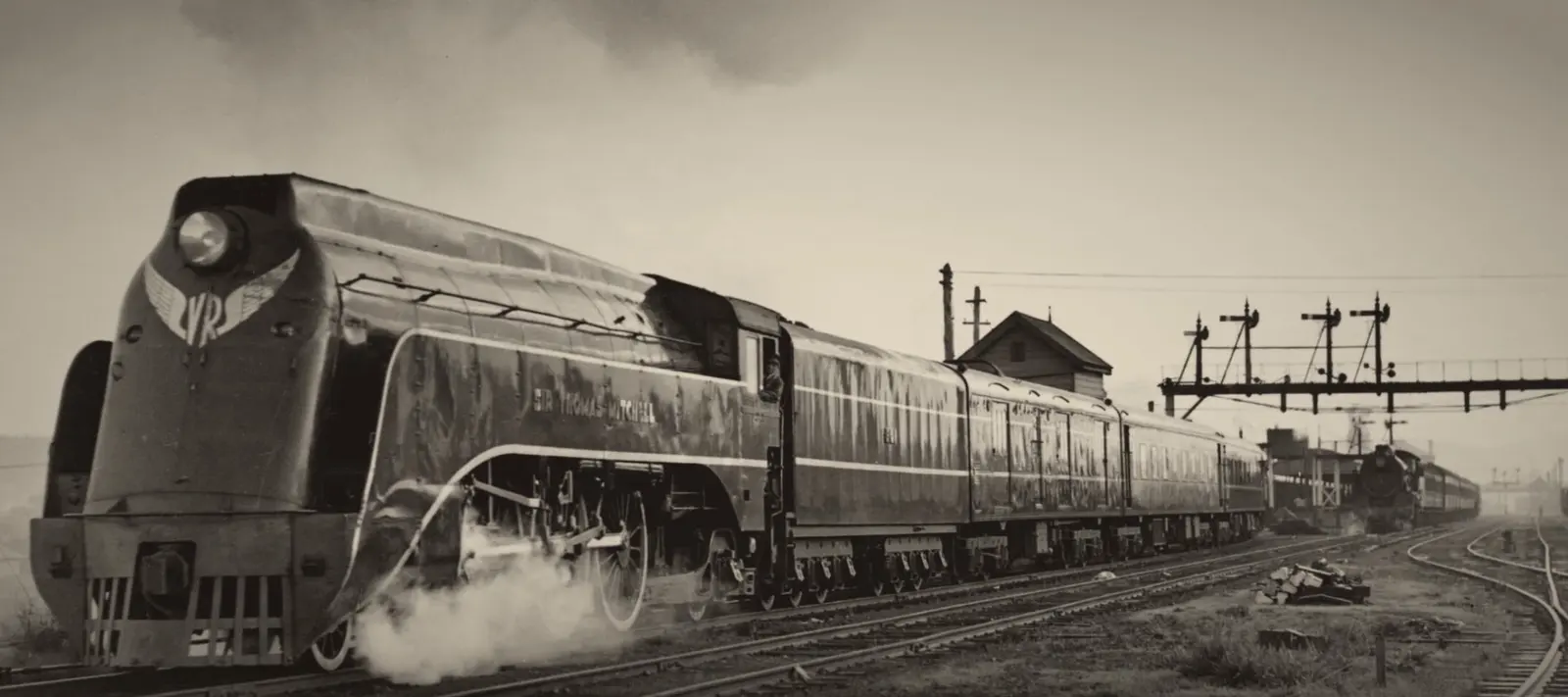
In January 1962, the first freight train ran on new standard gauge track from Albury to Melbourne. Through passenger trains followed in April. In its first full year, the line carried more than a million tons of freight.
In Western Australia, a new standard gauge line from Kalgoorlie carried its first freight to Perth in 1968. Passenger trains followed in 1969.
The link from Broken Hill to Port Pirie came next. On 23 February 1970, the first Indian Pacific left Sydney for Perth. 4,352 kilometres, with no change of gauge.
In 1980, a new standard gauge line was finished from Tarcoola to Alice Springs, about 830 kilometres long. It replaced a flood-prone narrow gauge line through the Centre.
Adelaide itself was still broad gauge. In 1982, a standard gauge line into the city opened at last.
In 1995, the line from Melbourne to Adelaide was converted to standard gauge. For the first time, the mainland state capitals were linked on one gauge.
In 2004, the 1,420 kilometre line from Alice Springs to Darwin opened. The north coast was joined too.
Three gauges, year by year
Lines appear in the year they opened, coloured by the gauge they were built to. Diamonds are the towns where passengers changed trains. The last step shows the gauges in use today.
- 185412 Sep 1854
First steam railway opens in Melbourne (broad)
Source: en.wikipedia.org - 185526 Sep 1855
Sydney to Parramatta Junction opens (standard)
Source: en.wikipedia.org - 1865
Queensland opens Ipswich to Grandchester (narrow)
Source: en.wikipedia.org - 188314 Jun 1883
Sydney and Melbourne lines meet at Albury
Source: hms.heritage.nsw.gov.au - 188816 Jan 1888
Sydney and Brisbane lines meet at Wallangarra
Source: en.wikipedia.org - 191717 Oct 1917
Trans-Australian Railway halves meet at Ooldea
Source: en.wikipedia.org - 1962January and April 1962
Albury to Melbourne standard gauge: freight then passenger
Source: en.wikipedia.org - 197023 Feb 1970
First Indian Pacific Sydney to Perth
Source: en.wikipedia.org - 1995
Melbourne to Adelaide converted to standard; mainland capitals joined
Source: en.wikipedia.org - 2024December 2024
The network today: about 56 per cent standard gauge, 35 per cent narrow and 8 per cent broad, by route length.
BITRE Trainline 12, Table 28
The full record, 26 entries
- 1848 Earl Grey advises one uniform gauge of 4 ft 8.5 in Source: en.wikipedia.org
- 1850 Sheilds persuades the Sydney Railway Company to adopt 5 ft 3 in Source: en.wikipedia.org
- 1853 NSW advises the 5 ft 3 in Act will be repealed (Wallace) Source: en.wikipedia.org
- 1853 Victoria keeps 5 ft 3 in Source: en.wikipedia.org
- 1854 First steam railway opens in Melbourne (broad) Source: en.wikipedia.org
- 1855 Sydney to Parramatta Junction opens (standard) Source: en.wikipedia.org
- 1856 Adelaide to Port Adelaide opens (broad) Source: en.wikipedia.org
- 1865 Queensland opens Ipswich to Grandchester (narrow) Source: en.wikipedia.org
- 1879 WA opens Geraldton to Northampton (narrow) Source: en.wikipedia.org
- 1883 Sydney and Melbourne lines meet at Albury Source: hms.heritage.nsw.gov.au
- 1888 Sydney and Brisbane lines meet at Wallangarra Source: en.wikipedia.org
- 1901 Federation; intercolonial customs end Source: en.wikipedia.org
- 1917 Trans-Australian Railway halves meet at Ooldea Source: en.wikipedia.org
- 1921 Royal Commission recommends standard; PM and Premiers agree Source: austlii.edu.au
- 1930 Standard gauge reaches South Brisbane via Kyogle Source: en.wikipedia.org
- 1945 Clapp Report Source: en.wikipedia.org
- 1956 Wentworth committee picks three trunk projects Source: en.wikipedia.org
- 1962 Albury to Melbourne standard gauge: freight then passenger Source: en.wikipedia.org
- 1969 Kalgoorlie to Perth standard gauge fully open Source: en.wikipedia.org
- 1970 First Indian Pacific Sydney to Perth Source: en.wikipedia.org
- 1980 Tarcoola to Alice Springs standard gauge Source: en.wikipedia.org
- 1982 Standard gauge into Adelaide (work 1982 freight 1983 passengers 1984) Source: en.wikipedia.org
- 1995 Melbourne to Adelaide converted to standard; mainland capitals joined Source: en.wikipedia.org
- 2004 Alice Springs to Darwin opens Source: en.wikipedia.org
- 2010 Seymour to Albury broad converted to standard Source: en.wikipedia.org
- 2024 The network today: about 56 per cent standard gauge, 35 per cent narrow and 8 per cent broad, by route length. BITRE Trainline 12, Table 28
Australia still runs three gauges
Yet Australia still has three gauges. In December 2024, there were about 31,200 kilometres of operating heavy railway.
About 56 per cent is standard gauge. About 35 per cent is narrow, most of it in Queensland and Western Australia. About eight per cent is broad, nearly all in Victoria.
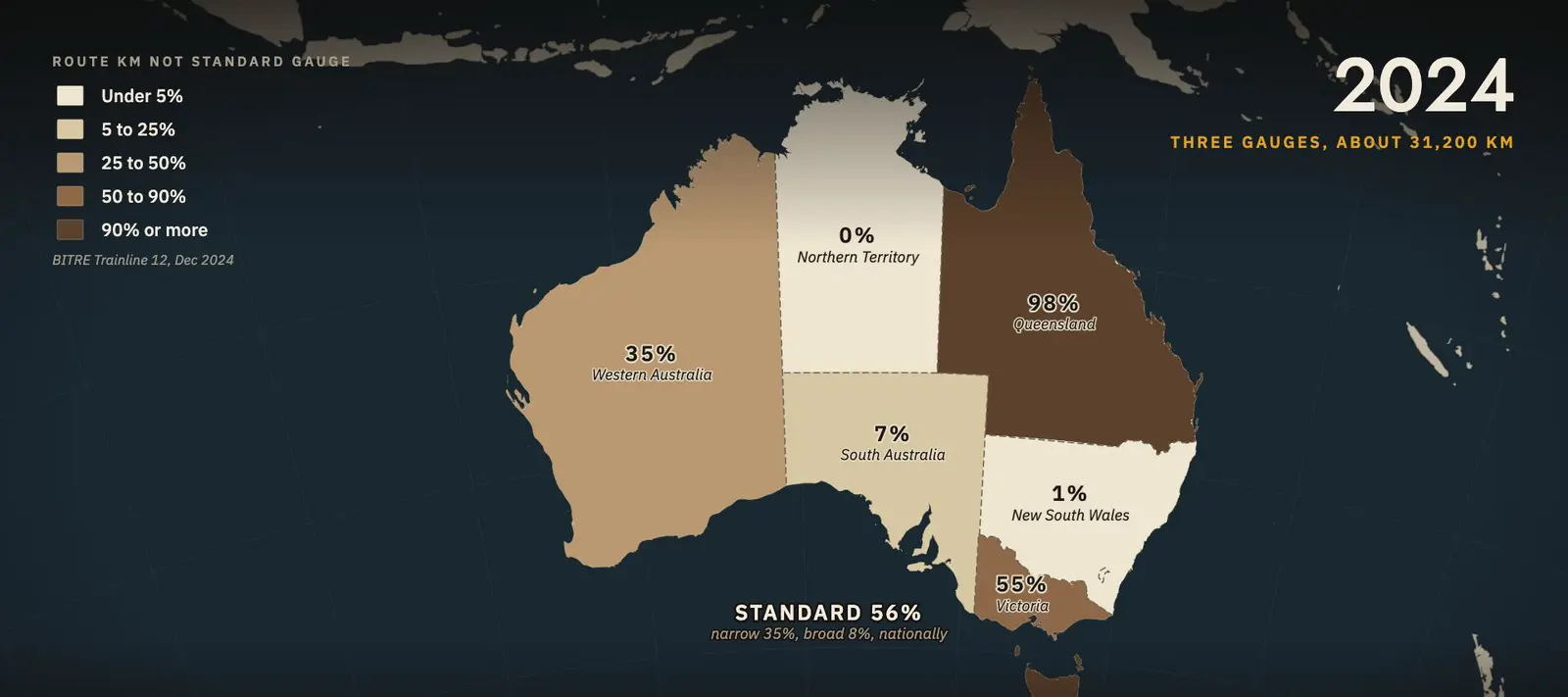
Queensland's network is still built around three feet six. Victoria's regional lines are still largely five feet three. Where two gauges share a corridor, some track carries a third rail, so trains of both widths can use it.
One South Australian line, to Mount Gambier, was converted from narrow to broad in the 1950s. It was meant to become standard later. It closed in 1995, still broad.
Even now, the work goes on. Around 2010, about 200 kilometres of the line north of Seymour were converted from broad to standard.
It began with a few letters by ship
The first decision took a few letters, carried by ship. Undoing it took a Royal Commission, decades of committees, and more than a century of work.
On a railway, the first few kilometres decide the next hundred years.
Fact check and sources
Mark Twain, changing trains at Albury in September 1895:
“Think of the paralysis of intellect that gave that idea birth”
Mark Twain, Following the Equator, 1897, chapter XIV
Checked against the record
- Albury, 1895 The change of trains at the border.
routed out of their snug beds by lantern-light in the morning
Following the Equator, ch. XIV - 56 per cent Standard gauge in the network today. Standard 1,435 mm: 17,544.3 route km, about 56% of 31,212.6 km of open heavy railway, December 2024 BITRE Trainline 12, Table 28
Sources
- BITRE, Trainline 12, Table 28, Aug 2025
- Victorian Railways, Annual Report 1961 to 1962
- Victorian Railways, Annual Report 1962 to 1963
- Royal Commission on Uniform Railway Gauge, 1921
- NSW State Heritage Register, Albury Railway Station
- Queensland Heritage Register, Wallangarra station
- Sydney Morning Herald, 13 Dec 1850
- South Australian Register, 12 Oct 1880
- The West Australian, 18 Oct 1917
- Sydney Morning Herald, 27 Sep 1930
- The Argus, 13 Sep 1854
- The Advertiser, 21 Mar 1942, via Smithsonian Magazine
- The Age, 22 Feb 2010
- Mark Twain, Following the Equator, 1897
- J. A. Mills, The Myth of the Standard Gauge, Griffith University thesis, 2007
- ICE, obituary of F. W. Sheilds, 1907
- NSW Railway Commissioners, Annual Report 1889, NSW tabled papers
- ABS, Year Book Australia 2005
- National Railway Museum, Time line of rail in South Australia
- P. Laird, Back on Track, UNSW Press, 2001
- Railways and Tramways of Australia, Albury station
- Wikipedia, Rail gauge in Australia (as a guide only)
- Map data: Natural Earth; Geoscience Australia; OpenStreetMap contributors (ODbL)
- Terrain: USGS SRTM and Geoscience Australia via AWS Terrain Tiles
Pictures on this page
- Victorian S301 and NSW 3606 at Albury, about 1930s · National Library of Australia, nla.obj-155066202. Out of Copyright. Reason for copyright status: Created/Published Date is Before 1955 · Source
- First train at Parramatta, W. G. Mason, 1857 · National Library of Australia, nla.obj-138452395. Out of Copyright. Reason for copyright status: Created/Published Date is Before 1955 · Source
- Break of gauge at Terowie, E. S. Maclean, 1927 · National Library of Australia, nla.obj-133769602. Out of Copyright. Reason for copyright status: Created/Published Date is Before 1955 · Source
- Wood, Ooldea, 1919 · Museums Victoria, MM 3739. Public Domain (licence: Public Domain Mark, https://creativecommons.org/publicdomain/mark/1.0/) · Source
- Film stills, loops, maps and diagrams: from the Backstory Report film, drawn from the sources above.
Every archive picture in the film, with its rights (24)
- City railway terminus, Sydney, S. T. Gill, 1856 · National Library of Australia, nla.obj-135667504. Out of Copyright. Reason for copyright status: Creator Date of Death is Before 1955 · Record
- Long Cove viaduct, Sydney and Parramatta Railway, 1857 · National Library of Australia, nla.obj-138452140. Out of Copyright. Reason for copyright status: Created/Published Date is Before 1955 · Record
- First train at Parramatta, W. G. Mason, 1857 · National Library of Australia, nla.obj-138452395. Out of Copyright. Reason for copyright status: Created/Published Date is Before 1955 · Record
- Sir Charles FitzRoy, Governor of NSW, 1847 · National Library of Australia, nla.obj-148451056. Out of Copyright. Reason for copyright status: Creator Date of Death is Before 1955 · Record
- Clipper Marco Polo, about 1860 · National Library of Australia, nla.obj-137247182. Out of Copyright. Reason for copyright status: Since 1930 [Created/Published Date + 70 Years] · Record
- City terminus, M. & H.B. Railway, S. T. Gill, 1854 · National Library of Australia, nla.obj-142613503. Out of Copyright. Reason for copyright status: Since 1950 [Creator Date of Death + 70 Years] · Record
- The Railway Pier, Sandridge, about 1858 · State Library Victoria, H84. This work is out of copyright · Record
- Hobson's Bay railway pier, C. Nettleton, about 1875 · State Library Victoria, H4514. This work is out of copyright · Record
- Bremer railway bridge near Ipswich, 1868 · National Library of Australia, nla.obj-133120355. Out of Copyright. Reason for copyright status: Creator Date of Death is Before 1955 · Record
- Senators at Albury station, E. T. Luke, 1902 · National Library of Australia, nla.obj-140781394. Out of Copyright. Reason for copyright status: Created/Published Date is Before 1955 · Record
- Albury station from the north end, R. B. McMillan, 30 Sep 1939 · National Library of Australia, nla.obj-155288992. Out of Copyright. Reason for copyright status: Created/Published Date is Before 1955 · Record
- Albury, southern end, 8 Nov 1947 · National Library of Australia, nla.obj-155288191. Out of Copyright. Reason for copyright status: Created/Published Date is Before 1955 · Record
- Victorian S301 and NSW 3606 at Albury, about 1930s · National Library of Australia, nla.obj-155066202. Out of Copyright. Reason for copyright status: Created/Published Date is Before 1955 · Record
- Mark Twain, A. F. Bradley, about 1908 · National Library of Australia, nla.obj-148775329. Out of Copyright. Reason for copyright status: Created/Published Date is Before 1955 · Record
- Break of gauge at Terowie, E. S. Maclean, 1927 · National Library of Australia, nla.obj-133769602. Out of Copyright. Reason for copyright status: Created/Published Date is Before 1955 · Record
- Lord Kitchener, about 1910 · National Library of Australia, nla.obj-138296659. Out of Copyright. Reason for copyright status: Since 1980 [Created/Published Date + 70 Years] · Record
- Track-laying machine, Trans-Australian Railway, J. Flynn, about 1915 · National Library of Australia, nla.obj-142273551. Out of Copyright. Reason for copyright status: Created/Published Date is Before 1955 · Record
- Wood and water train, Ooldea, South Australia, 23 May 1919 · Museums Victoria, MM 3737. Public Domain (licence: Public Domain Mark, https://creativecommons.org/publicdomain/mark/1.0/) · Record
- Wood, Ooldea, 1919 · Museums Victoria, MM 3739. Public Domain (licence: Public Domain Mark, https://creativecommons.org/publicdomain/mark/1.0/) · Record
- A train at Kalgoorlie, 1935 · Museums Victoria, MM 1612. Public Domain (licence: Public Domain Mark, https://creativecommons.org/publicdomain/mark/1.0/) · Record
- Spirit of Progress leaving Albury, about 1940 · National Library of Australia, nla.obj-155042025. Out of Copyright. Reason for copyright status: Created/Published Date is Before 1955 · Record
- Map of NSW Railways, J. D. Edward, about 1890 · National Library of Australia, nla.obj-149697194. Out of Copyright. Reason for copyright status: Created/Published Date is Before 1955 · Record
- Australia railway systems, gauge analysis, 1923 · National Library of Australia, nla.obj-142327967. Out of Copyright. Reason for copyright status: Created/Published Date is Before 1955 · Record
- Principal railway systems of Australia, 1938 · National Library of Australia, nla.obj-711890532. Out of Copyright. Reason for copyright status: Since 2008 [Created/Published Date + 70 Years] · Record
Corrections. None to this case so far. Every correction is dated on the sources and corrections page.
Related cases
All cases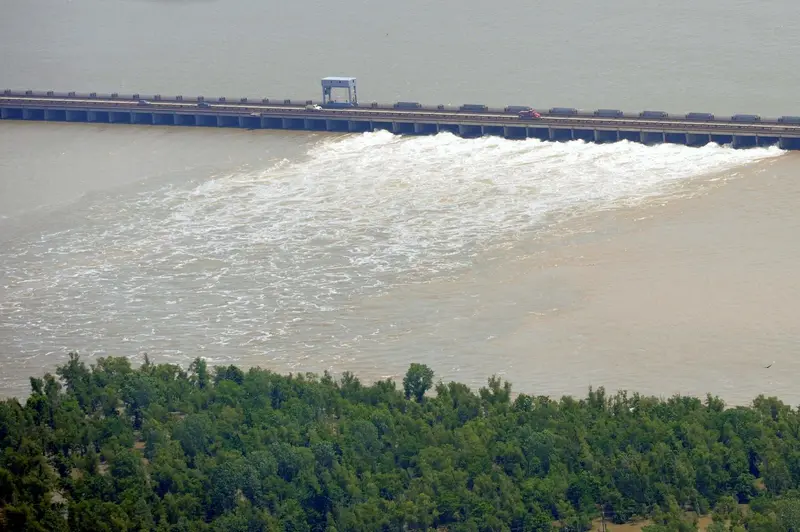
Why the Mississippi Wants a New Path to the Sea
The Atchafalaya offers the Mississippi a route to the Gulf less than half as long. Gates have held it back since 1962.
Why a Quarter of the Netherlands Is Below Sea Level
About a quarter of the country lies below sea level, and much of it sank because people drained it.
A 767 Runs Out of Fuel Mid-Flight
The gauges were blank, so the fuel was measured by hand. One factor turned litres into the wrong unit.